
Lesson Zero
Lesson Zero
Couldn't load pickup availability
Digital Files
Digital Files
Important to keep in mind: when you click the buy button on any product in this e-commerce, you are purchasing purely digital products designed to help you create incredible printable assets in both 2D and 3D. All the training needed to develop these skills — including 2D printing, 3D printing, and asset creation workflows — is acquired by reading the e-books from the epic lore of Kwasar: Chronicles of Heroes. Through these e-books, you gain not only access to the stories of the Kwasar Universe, but also entry to the Arkademy, where you’ll find all the knowledge and skills required to become a creator and build your own 2D and 3D assets.”
AGE RECOMENDATION 16+
AGE RECOMENDATION 16+
Age Recommendation for Website Content (16+)
Our stories feature intricate plotlines, deep character development, and mature themes designed for a more experienced audience. While our content is suitable for readers 16 and older, we advise discretion, as some narratives may include complex themes, sophisticated language, and intense scenarios.
Parental guidance is recommended for readers under 16, and we encourage guardians to assess content suitability based on individual maturity levels.
This recommendation helps ensure an enjoyable and appropriate experience for all. We appreciate your understanding and cooperation.
Unofficial Educational Resource
Unofficial Educational Resource
Important Note – Independent and Unofficial Educational Resource:
This website is an independent and unofficial educational resource created to help players learn and enjoy Dungeons & Dragons.
We are not affiliated with, endorsed by, or officially connected to Wizards of the Coast LLC or Hasbro.
Our sole purpose is to introduce, teach, and expand awareness of the game to as many players as possible, driven by our passion for the hobby and our respect for its creators.
All educational content on this website is based on the System Reference Document (SRD) 5.2.1, which are released under the Creative Commons Attribution 4.0 International License (CC-BY-4.0). This allows us to use, adapt, and teach these rules freely, provided that proper attribution is given to the original creators.
Attribution Notice:
This work includes material from the System Reference Document 5.2.1 (SRD 5.2.1) by Wizards of the Coast LLC, available at:
https://www.dndbeyond.com/srd
The SRD 5.2.1 is licensed under the Creative Commons Attribution 4.0 International License (CC-BY-4.0):
https://creativecommons.org/licenses/by/4.0/legalcode
We fully respect and recognize the work of Wizards of the Coast LLC, and we strongly encourage all players to support the official game by purchasing original materials such as the Player’s Handbook, Dungeon Master’s Guide, and Monster Manual, which are widely available online and in stores. Our mission is to share knowledge, celebrate creativity, and help grow the global community of players, while always giving proper credit to the creators and respecting their intellectual property.
 Hi, ArKader, welcome to your first lesson on how to play Dungeons & Dragons.
Let me warm things up and begin by telling you this incredible story, designed to inspire you.

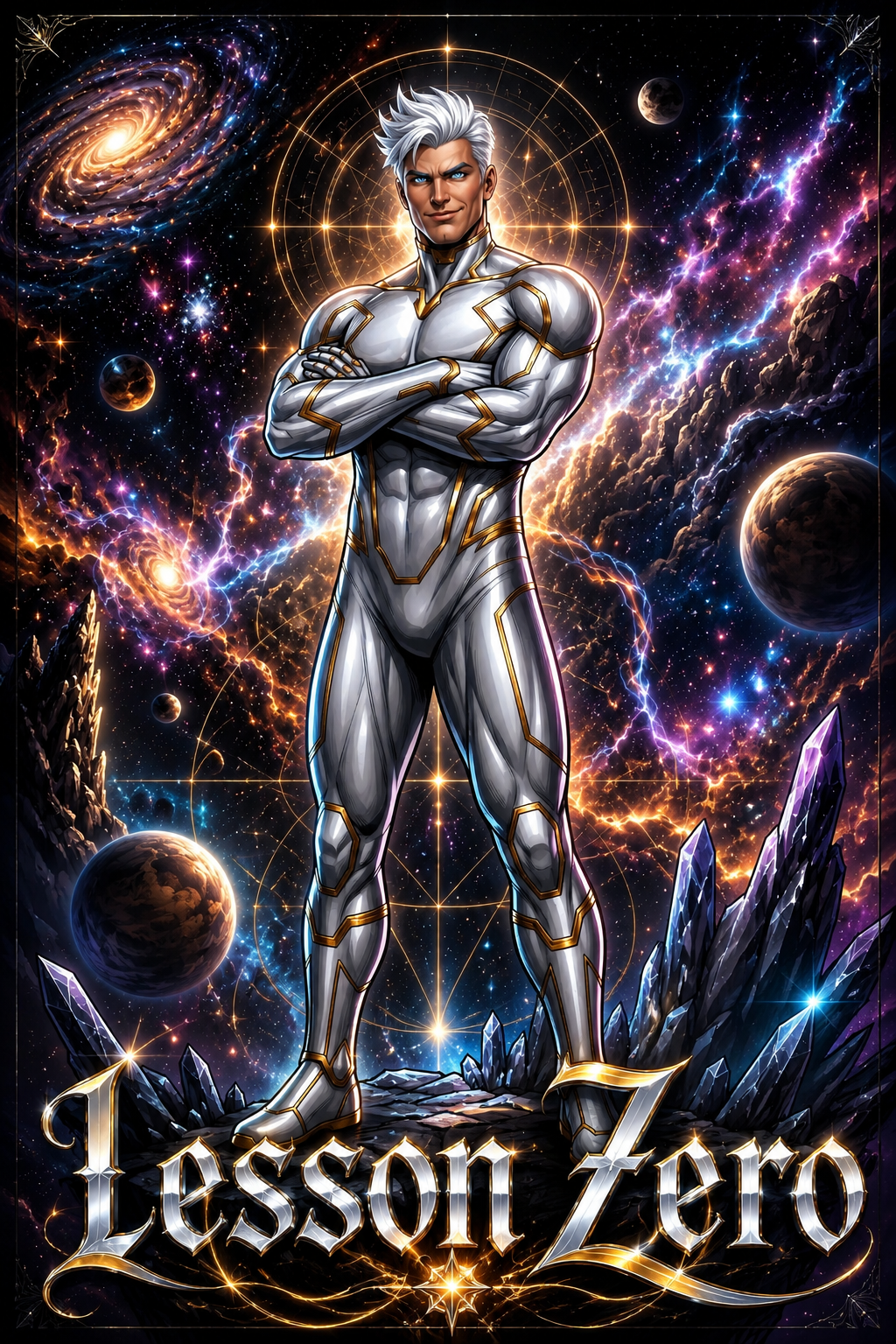
Genesis, The First Prime Hero
Before the first crown, before the first temple, before the first warrior raised a blade beneath the stars, there was Goddark.
He stood alone upon the edge of creation, surrounded by galaxies, newborn suns, ancient moons, and rivers of celestial fire. His hair was white like the first light of existence, his eyes burned with cold blue intelligence, and his face carried the calm confidence of a being who had seen galaxies rise before time itself had learned to breathe.
Around his body flowed the Sublime Skin, the sacred and unmistakable vestment of the Architects of Tzion. It was not armour, nor cloth, nor mortal fabric. It was a divine second skin, seamless and immaculate, sculpted from pure white cosmic matter and traced with golden lines like the geometry of creation itself. Every golden contour across his chest, arms, and legs seemed to follow hidden laws of the universe, as if his body had been written in the language of stars.
The Sublime Skin did not protect him because he was fragile.
It revealed what he truly was.
An Architect.
A maker of worlds.
A sovereign intelligence capable of shaping matter, energy, destiny, and life.

👆👆👆 Get the original digital illustration in Full HD and use it to create your own physical tokens, just like the example shown here.
Please note: You are downloading the JPG image file, which you can print, cut, and use to create your own tokens for your D&D adventures.
Hit the buy button above to download the digital bundle with all the images featured in this lesson.
It is completely Free!
The Mother Planet
So, Goddark was the Architect of Tzion, the divine mind that had shaped the laws of its newborn reality. Yet in the hidden wounds of his spirit, there remained a name he could not forget.
Primo.
The tragedy of Primo had not destroyed Goddark, but it had broken something sacred within him. His trust had been wounded. His certainty had been poisoned. The Altiverse, the spiritual soul of the Universe, once felt like a palace of infinite light. After Primo, it felt like an endless chamber of echoes.
So Goddark made a decision.
He would no longer remain only in the spiritual realm. He would enter the physical Universe of Tzion. He would touch matter. He would feel gravity. He would breathe the air of his own creation.
And at the very centre of Tzion, he created the mother planet.
Urkulo.

👆👆👆 Get the original digital illustration in Full HD and use it to create your own physical tokens, just like the example shown here.
Please note: You are downloading the JPG image file, which you can print, cut, and use to create your own tokens for your D&D adventures.
Hit the buy button above to download the digital bundle with all the images featured in this lesson.
It is completely Free!
If you look at Urkulo from the vastness of space, you may think, for a brief moment, that it resembles Earth. But Urkulo is nothing like Earth.
Urkulo is the Mother Planet — the original world from which planets like Earth draw their ancient reflection, and that is why the resemblance exists.
Earth-like worlds are only distant echoes of its design, fragments of its memory, shadows of its beauty. Urkulo is not simply another planet among the stars; it is the sacred planetary origin, the cradle of impossible life, the first great womb of Tzion. And simply for your understanding, Urkulo is not the size of Earth. It is almost unimaginable in scale: ten thousand times larger than the planet Earth, a colossal living world of mountains, oceans, forests, civilizations, mysteries, and divine power.
Kronos
There, upon Urkulo, Goddark took flesh.
And when the Architect became physical, he was no longer called only Goddark.
He became Kronos.
For the first time, the creator walked inside his own creation.

👆👆👆 Get the original digital illustration in Full HD and use it to create your own physical tokens, just like the example shown here.
Please note: You are downloading the JPG image file, which you can print, cut, and use to create your own tokens for your D&D adventures.
Hit the buy button above to download the digital bundle with all the images featured in this lesson.
It is completely Free!
He felt wind strike his face. He felt rain slide over his skin. He felt the weight of his body upon the soil. He looked at the stars not as an Architect watching from above, but as a living being standing beneath them.
And beneath the sacred earth of Urkulo, he found the substance from which all future life would be born.
The universal clay.
The genetic source of all creatures.
The sacred matter known as Ex-Codice.
Within the Ex-Codice slept the possibility of every beast, every race, every civilization, every Sapiens yet to exist. It was not mud in the simple sense. It was memory before memory. Flesh before flesh. Destiny before destiny.
Kronos knelt before it.
For a long time, he did not move.
He had created planets before. Stars. Laws. Oceans. Light.
But this was different.
This was life with thought.
Life with soul.
Life capable of looking back at him.
Slowly, he placed his hands into the Ex-Codice.
At first, nothing happened.
Then the clay began to tremble.
A pulse moved through the soil of Urkulo. The mountains answered with deep thunder. The rivers stopped flowing. The winds fell silent. Even the stars seemed to lean closer.
And then something within Kronos broke open.
Not weakness.
Power.
A terrible, beautiful eruption of divine force.
All the sorrow left by Primo. All the loneliness. All the hope. All the desperate desire to create something pure, something untouched by betrayal, something that could begin again where trust had died.
It poured from him in a single impossible explosion.
The Ex-Codice rose in spirals, shining like liquid night. It wrapped itself in light, in blood, in breath, in shape. The air burned violet and gold. The ground cracked beneath the pressure of creation.
And from that storm, she emerged.
A woman.
The first Sapiens.
Genesis

👆👆👆 Get the original digital illustration in Full HD and use it to create your own physical tokens, just like the example shown here.
Please note: You are downloading the JPG image file, which you can print, cut, and use to create your own tokens for your D&D adventures.
Hit the buy button above to download the digital bundle with all the images featured in this lesson.
It is completely Free!
She opened her eyes beneath the newborn stars, and the Universe seemed to become aware of itself.
Her hair fell around her shoulders like liquid night, black as the silence before the first dawn, moving gently with the breath of the living forest that surrounded her. Her eyes were dark and profound, not empty, but infinite — as if the first shadows of creation had gathered inside them to witness the birth of consciousness. She stood among ancient trees, moss-covered roots, wild flowers and sacred green light, wearing a simple white dress that flowed to the earth like untouched moonlight. There was no crown upon her head, no armour around her body, no weapon in her hands, and yet the world seemed to bow around her.
Her beauty was not merely physical; it was the beauty of something created before imperfection had learned how to exist. She was grace before shame, strength before violence, innocence before fear. The forest did not surround her like a prison, but like a temple. The branches curved above her as if nature itself had formed an archway for her arrival, and the leaves moved around her like whispers of the first language of life.
She looked fragile only to those who did not understand creation.
Because beneath that calm face, beneath that white garment, beneath that untouched silence, there was the first spark of a destiny that would one day shake the stars.
The Genesis Mark.
Thus, long before Kronos himself fully understood what had begun, a seed was planted in the future of the Kwasar Empire.
Genesis had not yet become a Kwasar.
Not yet.
She was still the first Sapiens of the Universe, the first living miracle shaped from Ex-Codice, the first pure flame born from the hands of Kronos. But Kronos knew — deep within the silence of his divine heart — that her destiny would not end as Sapiens.
Soon, she would become something greater.
Soon, she would become the first Kwasar.
And from that sacred destiny, a law without words began to form: every Kwasar who would ever rise after her would be shaped in the image and likeness of Genesis — the first Sapiens, the future first Kwasar, the one from whom all heroic beauty would take its measure.
This would become known as The Genesis Mark.
In eternal reverence to her, every Kwasar would be born with eyes as black as Genesis’s first gaze, deep as the silence between galaxies, and hair as black as hers — black as the unborn night, black as the void before the first star, black as the sacred darkness from which the Universe itself had awakened.
For Genesis was not merely the first.
She was the pattern.
The origin.
The sacred image from which the future of all Kwasars would one day rise.

👆👆👆 Get the original digital illustration in Full HD and use it to create your own physical tokens, just like the example shown here.
Please note: You are downloading the JPG image file, which you can print, cut, and use to create your own tokens for your D&D adventures.
Hit the buy button above to download the digital bundle with all the images featured in this lesson.
It is completely Free!

Hey, take a breath.
It is time for a pause.
It is time for your first interlude.
Interludes are small training pills designed to help you play D&D Like Never Before, while learning the basics and discovering incredible skills.
Here is your first interlude, which I am sharing with you just below.
INTERLUDE: Start your D&D journey
Legal Notice & Attribution
This work is an independent, unofficial educational manual based exclusively on content released by Wizards of the Coast under the Creative Commons Attribution 4.0 International License (CC-BY 4.0), specifically the System Reference Document (SRD) 5.1 and SRD 5.2 / 5.2.1.
Dungeons & Dragons, D&D, and all related trademarks, logos, and brand names are the property of Wizards of the Coast LLC. This work is not affiliated with, endorsed, sponsored, or approved by Wizards of the Coast or Hasbro.
All game mechanics, rules concepts, and references included in this manual are derived solely from SRD content that has been legally made available for public use under Creative Commons. Any original explanations, teaching methods, structure, creative skills, artwork, lore references, and educational frameworks presented here are original to this work.
Attribution is provided as required by the Creative Commons license:
“This material is based on content from the Dungeons & Dragons System Reference Document (SRD) © Wizards of the Coast LLC, used under the Creative Commons Attribution 4.0 International License.”
This manual is intended for educational and creative purposes only. It does not reproduce or replace official Dungeons & Dragons rulebooks, nor does it attempt to replicate their structure, wording, or proprietary content.
Readers who wish to explore Dungeons & Dragons in greater depth, access expanded rules, official settings, adventures, and premium content are strongly encouraged to support the original creators by purchasing the official publications released by Wizards of the Coast.
Dungeons & Dragons exists thanks to the work of its designers, writers, artists, and developers. This guide is created with respect for that legacy and with the goal of helping new players learn, enjoy, and eventually deepen their engagement with the official game.
Welcome to How to Play D&D — an independent and unofficial guide for gamers ready for adventure.
This guide is based on the System Reference Document (SRD) 5.2.1, released under the Creative Commons Attribution 4.0 International License (CC-BY-4.0). It is designed to teach you, step by step, the fundamental rules of Dungeons & Dragons in a clear, practical, and engaging way.
Here, you will learn everything you need to begin your journey: how to create your character sheet, understand ability scores, build your character’s background, and choose your class and race. You will explore core mechanics such as hit points, combat, resting, and progression, along with the essential concepts that bring the game to life.
From your first character to your first adventure, this guide will give you the tools and confidence to start playing and fully experience the magic of Dungeons & Dragons.
What is D&D?
Close your eyes.
Now imagine a world where your choices shape reality. Where your words summon storms, your courage saves kingdoms, and your imagination brings entire universes to life. Where you can be anything—a silver-tongued bard, a vengeful sorcerer, a noble paladin with a broken past.
That’s not a video game. It’s not a movie. It’s not something you passively watch.
That’s Dungeons & Dragons.
And it’s magic, in the truest sense of the word.

🎲 More Than a Game—It’s a Portal to Who You Really Are
People don’t fall in love with D&D because of the dice or the stats.
They fall in love with it because it lets them feel things they didn’t know they needed to feel.
In a world full of filters and roles we’re expected to play, D&D lets you explore other sides of yourself—safely, wildly, freely. You can be brave when you’re usually shy. You can forgive when you never could before. You can take a bullet (or a fireball) for someone who’s just a voice across the table—and mean it.
And maybe, just maybe, you’ll learn that the part of you pretending to be brave… wasn’t pretending at all.
🔥 Why It Feels So Damn Good
Because when you’re deep in a story—laughing, risking, saving someone with one last desperate spell—your brain lights up like fireworks.
Your body doesn’t know it’s “just a game.”
It feels like triumph. It feels like fear. It feels like love.
And those emotions? They’re real.
They stay with you long after the dice stop rolling.
🤝 A Table Where You Truly Belong
You don’t just play Dungeons & Dragons.
You gather. Around tables, in living rooms, over video calls. You make time in your chaotic life to sit with others and create something that didn’t exist before you got together.
You’ll laugh so hard you cry. You’ll cry for fictional characters that meant more than you expected. You’ll argue about a plan for an hour only to have someone say, “I jump in the hole,” and somehow it all works out.
But most of all?
You’ll build friendships that run deeper than you ever imagined.
Not because of the game.
Because of what the game brings out in people.

💡 Why It Stays With You Forever
Every player has that one story they never forget.
The time they rolled a natural 20 and saved the world. The time they made peace instead of war. The time they died to protect someone else’s character—and it meant something.
These stories aren’t scripted. They’re not “content.”
They’re lived.
And because they’re yours, they become part of your story, too. The real one.
The one you’re writing, moment by moment, word by word.

🐉 And Yes—There Are Dragons
There are dragons and gods and haunted forests and relics forged in forgotten flames. There are mysteries in ancient tongues and maps with edges that fade into myth.
But here’s the thing: the real treasure isn’t the loot.
It’s not the XP.
It’s not even a victory.
The real treasure… is you.
The you who dared. The you who believed.
The you who made others feel something they’ll remember for the rest of their lives.
🗺️ So Why Does Everyone Love Dungeons & Dragons?
Because it lets us be heroes in a world that too often tells us we’re not enough.
Because it gives us a voice when the world tells us to be quiet.
Because it teaches us that the impossible is only impossible until someone imagines it differently.
Because when you sit down at that table, surrounded by people who want you there, and someone says:
“Okay… what do you want to do?”
You realize—
This is your story now.
And if you’re the one introducing someone to that world—if you’re the one opening that door—you don’t just look cool. You become a legend.
You become that friend they’ll always remember.
You become Kronos.
And yeah, buddy...
Kronos is the f*ing coolest.** 🐉🔥

Interludes are small knowledge pills — easy to digest and easy to understand.
Once you have read them and absorbed them, you can continue reading the incredible stories of Multiverse-Z.
The First Kwasar
Kronos stared at her, unable to speak.
He had intended to create life.
He had not expected to create wonder.
In that moment, he understood that what had happened could never be repeated. The explosion that had given birth to Genesis had come from a divine wound, from a grief so deep and a hope so pure that even he could not summon it again.
She was the first.
And because she was the first, she carried the magic of the unrepeatable.
She looked at him with newborn innocence.
“Who am I?” she asked.
Her voice was soft, but the Universe listened.
Kronos approached her slowly, almost afraid that if he moved too quickly, the miracle would vanish.
“You are Genesis,” he said. “The beginning.”
She looked at her hands, then at the world around her.
“And you?”
He hesitated.
“I am Kronos.”
But deep within her, though she did not yet understand why, she sensed that he was more than flesh.
More than a man.
More than a teacher.
He was the one from whom everything around her had come.
And yet he looked at her not with domination, but with astonishment.
For a time, they remained there in silence, creator and first creation, standing upon the sacred soil of Urkulo.
Then Kronos saw her heart.
He saw no corruption in it. No cruelty. No hunger for power. Only purity, curiosity, courage, and a tenderness so profound that it stirred something dangerous inside him.
Hope.
And because of that hope, he decided she would not remain only Sapiens.
She would become the first guardian of Tzion.
The first vessel of the higher union.
The first Kwasar.
Polaris
So Kronos lifted his gaze toward the unseen gates of the Altiverse and called forth one of the sacred spirits born from his own divine essence.
A Pioneer Spirit.
From the spiritual realm descended a being of impossible beauty.
She was feminine in form, though not flesh. Her hair flowed red like living fire. Her eyes shone green like the purest emeralds of Urkulo. Her body, covered by her Sublime Skin, was luminous, intangible, visible yet untouchable, a spirit shaped from loyalty, radiance, and ancient power.
The Sublime Skin
Allow me to explain something important.
Allow me to reveal what the Sublime Skin truly is.
By the end of this story, you will understand it perfectly. But for now, let me anticipate this: the Sublime Skin is one of the most iconic garments of the Kwasar Empire — a sacred symbol worn by those who serve Goddark, the Great Architect of all Sapiens.
Look at Polaris below.
Look at how she wears it with pride.
This is not merely clothing. It is not decoration. It is not armour in the ordinary sense.
The Sublime Skin is a sign of devotion, elegance, discipline and divine purpose. It represents loyalty to the Architect, reverence for the origin of all life, and the sacred duty carried by those chosen to protect the destiny of Tzion.
On Polaris, the Sublime Skin does not hide her light.
It reveals it.
It wraps around her luminous form like a second destiny, shaping her presence into something regal, celestial and untouchable. Every line, every curve, every sacred detail speaks of service, power and belonging.
For the servants of Goddark do not dress merely to be seen.
They dress to remember who they are.
And Polaris wears the Sublime Skin as it was meant to be worn:
with honour, with beauty, and with the silent authority of one who was born from divine fire.

👆👆👆 Get the original digital illustration in Full HD and use it to create your own physical tokens, just like the example shown here.
Please note: You are downloading the JPG image file, which you can print, cut, and use to create your own tokens for your D&D adventures.
Hit the buy button above to download the digital bundle with all the images featured in this lesson.
It is completely Free!
The Union
Genesis watched her descend with wide eyes.
“Is she alive?” she whispered.
“Yes,” said Kronos. “But not as you are. She is spirit. She is one of my Pioneers. If she joins with you, you will become something greater than Sapiens.”
Polaris came near.
For a moment, the two women looked at each other: one born from clay, the other born from spirit.
Then Polaris smiled.
There was no fear in Genesis.
She lifted her hand.
Polaris touched it.
And the union began.
Light burst outward across Urkulo. The forests bent beneath the pressure. The rivers leapt from their beds like silver serpents. A ring of violet flame expanded around Genesis, and her body arched as the Pioneer entered her soul.
It was not possession.
It was fusion.
The Sapiens gave flesh.
The Pioneer gave spirit.
Together, they became something new.
A Kwasar.
Genesis fell to her knees, gasping. Her heartbeat was thunder. Her blood felt like starlight. Every sound became sharper. Every colour became deeper. She could hear the movement of insects beneath leaves. She could feel the vibration of distant waterfalls through the soles of her feet.
Her muscles strengthened. Her reflexes awakened. Her vision became almost divine.
And when she rose again, her beauty had changed.
It had not become less human.
It had become more than human.

👆👆👆 Get the original digital illustration in Full HD and use it to create your own physical tokens, just like the example shown here.
Please note: You are downloading the JPG image file, which you can print, cut, and use to create your own tokens for your D&D adventures.
Hit the buy button above to download the digital bundle with all the images featured in this lesson.
It is completely Free!
Kronos stepped back.
He had been prepared for power.
He had not been prepared for this.
Genesis looked at him, frightened and amazed.
“What has happened to me?”
“You have become the first Kwasar,” he said. “The first protector of Tzion.”
She touched her chest.
“And Polaris?”
“She is within you. With you. Not beneath you. Not above you. A companion. A second flame sharing your soul.”
Inside her mind, Genesis felt a warm presence answer.
I am here.
Tears formed in her black eyes.
For the first time since her birth, she was not alone inside herself.
From that day onward, Kronos became her teacher.
Her Magister.
And she became his Prenova.
A new explosion of knowledge.
A soul awakening through instruction.
At first, Genesis learned like a child discovering existence. She asked why the moons followed the sky. Why rivers moved. Why stars did not fall. Why her heart hurt when she saw beauty. Why silence could feel full. Why Kronos sometimes looked at the horizon as if remembering something that wounded him.
He answered what he could.
But not everything.
Never Primo.
Not yet.

Time for another pause.
Time for another interlude.
It is time to learn how to create your own 2D tokens.
INTERLUDE: How to Create Your Own DIY Mini Tokens for D&D
This guide will show you how to create simple DIY Mini Tokens for playing D&D using 2D illustrations instead of traditional miniatures.
These tokens are small printable character pieces that can stand upright on the table using a simple card standing base. They are easy to make, affordable, and perfect for representing heroes, monsters, objects, spells, or anything you want to bring into your game.
What You Need
To create your own DIY Mini Tokens, you will need:
-
2D character illustrations
-
Adhesive photo paper
-
Thick card or cardboard
-
Scissors or a craft knife
-
Small card standing bases
-
A printer
You can easily find adhesive photo paper, thick card, and card standing bases on Amazon or in most stationery shops.
Step 1: Choose Your 2D Illustrations
All the 2D illustrations available on this website can be used to create your own printable tokens.
You can use them to represent:
Characters
Monsters
NPCs
Spells
Objects
Treasure
Creatures
Special effects
Simply choose the images you want to use for your game.

Step 2: Resize the Images
Before printing, place the images into a document and resize them to the size you want.
For mini tokens, we recommend making the images as small as possible while still keeping the character clear and visible.

You can print one image, but it is much better to fill the page with many different characters, objects, spells, or creatures. This way, you can create a complete set of tokens from one printed sheet.

Step 3: Print on Adhesive Photo Paper
Print your resized images onto adhesive photo paper.
This type of paper works like a sticker sheet. Once the images are printed and cut out, each token image becomes a small sticker.
Adhesive photo paper is ideal because it gives the token a clean, colourful finish and makes the final piece look more professional.

Step 4: Cut Out the Printed Images
Carefully cut out each image using scissors or a craft knife.
Try to cut as neatly as possible around the character or object. You can leave a small border around the image if you want the token to be easier to handle.
Once cut, peel the backing from the adhesive photo paper.

Step 5: Stick the Image onto Thick Card
Place the sticker onto a piece of thick card or cardboard.
The thicker the card, the better. A heavier card gives the token more strength and makes it easier to place inside the standing base.

We recommend using high-grammage card whenever possible, as the final token needs to be thick enough to stand properly.

Step 6: Cut Out the Card Token
After sticking the image onto the card, cut around it again.
Now you have a thicker, stronger 2D token ready to use.
You can make the token rectangular, shaped around the character, or leave a small base area at the bottom so it fits more easily into the standing base.

Step 7: Place the Token into a Standing Base
Take a small card standing base and slide the token into it.
These are the same type of small plastic bases often used to hold business cards, signs, or small display cards.

You can search online for:
card standing bases
mini card holders
plastic card stands
business card display stands
Once the token is placed into the base, it will stand upright on the table like a miniature.
Final Result
Your DIY Mini Token is now ready to play.
You have created a small 2D standing character that can be used on a battle map, grid, or tabletop surface.
It is a simple, affordable, and creative way to build your own collection of playable D&D characters without needing traditional 3D miniatures.

Simple Summary
Print the illustration on adhesive photo paper.
Cut it out.
Stick it onto thick card.
Cut the card again.
Place it into a standing base.
Play with your new DIY Mini Token

Now, after completing this tutorial, you understand the power of the illustrations you can download by hitting the buy button above.
What are you waiting for?
Download them now.
They are completely free.
Once you have downloaded them, keep reading the incredible story of Genesis.
Adore & Allure
The first powers he taught her were not weapons.
They were expressions.
“Power,” he told her, “must never begin with violence. A Kwasar must first learn to reveal the truth of the soul.”
He taught her Adore.
Through Adore, Genesis could change the colour of her hair at will. At first, it frightened her. Her black hair shimmered into silver, then gold, then deep blue.

👆👆👆 Get the original digital illustration in Full HD and use it to create your own physical tokens, just like the example shown here.
Please note: You are downloading the JPG image file, which you can print, cut, and use to create your own tokens for your D&D adventures.
Hit the buy button above to download the digital bundle with all the images featured in this lesson.
It is completely Free!
She laughed for the first time, and the sound struck Kronos more deeply than any song ever had.

👆👆👆 Get the original digital illustration in Full HD and use it to create your own physical tokens, just like the example shown here.
Please note: You are downloading the JPG image file, which you can print, cut, and use to create your own tokens for your D&D adventures.
Hit the buy button above to download the digital bundle with all the images featured in this lesson.
It is completely Free!
Then he taught her Allure.
Through Allure, she could change the colour of her eyes.
Green like forests. Amber like sunset. Red like battle. Blue like calm waters. Violet like cosmic mysteries.

👆👆👆 Get the original digital illustration in Full HD and use it to create your own physical tokens, just like the example shown here.
Please note: You are downloading the JPG image file, which you can print, cut, and use to create your own tokens for your D&D adventures.
Hit the buy button above to download the digital bundle with all the images featured in this lesson.
It is completely Free!
“These colours are not disguise,” said Kronos. “They are language. Kwasars do not express emotion only through the face. They may reveal their inner state through the body itself. Hair, eyes, aura, movement. The soul speaks through form.”
Genesis practiced for days.
Sometimes her hair became white as snow when she meditated. Sometimes her eyes burned gold when she felt courage. Sometimes both became blue when she listened to the sea.
But slowly, she began to notice something.
Whenever she changed her eyes to violet, Kronos looked at her differently.
Not with control.
Not with pride.
With peace.
As though violet reminded him of something lost, or something he still hoped to find.
So one evening, beneath the twin moons of Urkulo, Genesis chose violet and kept it.
Her eyes became radiant purple. Her black hair shimmered with hidden amethyst undertones when the moonlight touched it.
Kronos saw her and stopped walking.
She smiled softly.
“Does this color please you, Magister?”
He looked away for a moment, as if the question had reached somewhere too vulnerable.
“Yes,” he said. “It does.”
From then on, violet became her chosen expression in his presence.
And that was the first secret sign of love between them.
But love did not arrive like a storm at first.
It arrived like dawn.
Quietly.
Unavoidably.
At the beginning, Kronos resisted it. She was his creation. His student. The first life he had shaped. His duty was to guide her, not desire her companionship. Yet every day she became more than the miracle he had made.
The First Prime Heroe
Genesis became a faithful and devoted Prenova.
She challenged Kronos. Questioned him. Comforted him without knowing she was doing it.
And Genesis, innocent though she was, began to feel something she could not name.
When Kronos stood too close, her breath changed.
When his hand corrected her posture, the contact stayed in her skin long after he moved away.
When he praised her, warmth spread through her chest with such force that even Polaris stirred within her.
You feel deeply, Polaris whispered inside her.
Is it wrong? Genesis asked.
There was a pause.
Not all dangerous things are wrong. But all powerful things must be understood.
So Genesis tried to understand.
And failed.
Because love was not a lesson.
It was an awakening.
As her training deepened, Kronos taught her the Prime Ideal. He explained that the future heroes of Tzion would not be defined merely by strength, but by balance. A Sapiens could become intelligent and still fall into cruelty. A warrior could become powerful and still become a monster. A civilisation could become advanced and still become empty.
“The body must be honoured,” he told her. “Not worshipped. Honoured. Strength is discipline made visible. Beauty is harmony made visible. The mind must guide the body, and the spirit must guide the mind.”
So he trained her body with sacred seriousness.
They ran across mountain ridges until the sunrise burned behind them. They climbed cliffs with bare hands. They swam through freezing rivers. They meditated beneath waterfalls until her breath became steady as stone. They lifted, leapt, struck, balanced, and endured.
And Genesis changed.
Her body became the first heroic ideal of Tzion.
Athletic. Powerful. Feminine. Muscular without losing grace. Beautiful without fragility. Fierce without brutality.
She became what future artists would one day try to capture in statues, paintings, and heroic legends: the Prime Hero — the perfect union of physical excellence, mental clarity, and spiritual fire.
And this is how the Kwasars would one day be known across the Universe of Tzion.
The Kwasars were also called Pro-Sapiens — the next evolution of the Sapiens, beings who had surpassed the limits of ordinary flesh without abandoning the sacred origin from which they came.
But in the common tongue, among the peoples, kingdoms, cities, and worlds of Tzion, they were known by another name:
Prime Heroes.
The honour of the Sapiens.
The living elite of Tzion.
Those who carried beauty, discipline, power, and purpose beyond the boundaries of the mortal form.
Kronos looked upon her evolution with awe.
She was no longer merely the first Sapiens.
She was the first promise.
The proof that flesh could become sacred when guided by discipline.
The Kun Arts
Then came the Kun Arts.
Genesis trained in simple combat garments — light, practical, and made for movement. Nothing about her clothing sought beauty. It served discipline: bare freedom for the limbs, breath for the body, and silence for the mind.
But Kronos was different.
As always, he wore the Sublime Skin.
He never explained it. He never named it before her. He never spoke of why he always appeared in that sacred attire, nor why it seemed to cling to him not like fabric, but like something older than fabric — something alive with meaning.
And because he never explained it, Genesis became curious.
At first, she tried not to stare. But it was impossible.
The Sublime Skin fascinated her.
It was not armour, yet it carried the dignity of armour. It was not royal clothing, yet it made Kronos seem more sovereign than any crown could have done. It moved with him like shadow and light woven together. It seemed shaped from elegance, authority, restraint, and power. There was something magical in it, something unreachable, something almost divine.
To Genesis, it was more than an attire.
It was sublime.
And perhaps that was why, even before she understood its meaning, the image of Kronos wearing it remained carved in her memory like a sacred symbol.
Only later would she understand that the Sublime Skin was not merely what Kronos wore.
It was a sign.
A legacy.
A language of devotion, hierarchy, beauty, and power within the future Kwasar Empire.
But at that time, Genesis knew none of this.
She only knew that Kronos looked eternal.
And then, beneath the silent skies of Irkulo, he began to teach her.
“The Kun Arts,” said Kronos, “are not one martial discipline. They are the root of all combat disciplines. Every strike, every throw, every stance, every weapon form, every method of breath, every philosophy of motion that will one day emerge across the Universe exists here in seed form.”
He touched her forehead.
Knowledge entered her like lightning.
Not complete mastery.
Potential.
Thousands of movements, systems, rhythms, and principles unfolded in her mind.
She saw open-hand combat. Blade combat. Staff combat. Mounted combat. Aerial combat. Defensive redirection. Pressure-point striking. Grappling. Kicking. Circular movement. Linear assault. The silence before attack. The mercy after victory.
She staggered beneath the weight of it.
“I cannot hold all of this.”
“You can,” said Kronos. “But not at once. Knowledge is not mastery. It is only the map. Training is the road.”
And so the true training began.
Every morning, Genesis fought shadows created by Kronos from the Ex-Codice. Every afternoon, she sparred with constructs of beasts not yet born. Every evening, she meditated with Polaris, learning to let the Pioneer’s spiritual instincts flow through her nervous system without overwhelming her own will.
Two Warriors form one
Then Kronos taught her one of the highest arts of the true Kwasars.
The temporary materialisation of the Pioneer.
Using the Ex-Codice, he showed Genesis how to form a second body from universal clay. Not a separate being, not a clone, but a temporary vessel through which Polaris could become tangible while still remaining spiritually connected to Genesis.
The first attempt lasted only seconds.
The second lasted minutes.
The third nearly killed them both from exhaustion.
But finally, after many days, the clay rose, shaped itself, breathed, opened its blue eyes…
And Polaris stood physically before them.
Red hair.
Green eyes.
Radiant body.
Polaris wore her Sublime Skin — the same sacred style of garment worn by Kronos himself — and upon her luminous form, it looked exalted.
Genesis, however, still wore her conventional combat attire.
She had not yet been clothed in the symbols of the Kwasar Empire.
Not yet.
Polaris already looked like a servant of Goddark’s divine order.
Genesis still looked like a warrior in formation — powerful, beautiful, and disciplined, yet still standing at the threshold of the destiny that awaited her: still touched by spirit, yet bound to flesh.
Genesis wept and embraced her.
The two were one, and yet for one hour, they could stand apart.
Two warriors.
One bond.
One shared fire.
Their training became ferocious after that.
Genesis and Polaris fought together across the valleys of Urkulo. They moved like mirrored flames. They learned to strike from opposite angles, to exchange weapons mid-combat, to leap from one another’s momentum, to combine flesh and spirit into impossible battle rhythms.
Kronos watched them grow.
Then, one day, he entered the arena himself.
It was not an arena built by hands. It was a circular valley surrounded by black cliffs, its ground hardened by ancient cosmic heat. Above it, storm clouds gathered though there had been no storm moments before.
“Today,” said Kronos, “you will face me.”
Genesis looked at Polaris.
Polaris smiled.
They attacked together.
The valley exploded.
Genesis came first, low and fast, her fist wrapped in violet force. Polaris descended from above, her heel burning with blue spiritual light. Kronos moved once. The two attacks missed him by the width of a breath.
He struck the air with two fingers.
A shockwave hurled them backward.
They recovered before hitting the ground, twisting mid-air, landing on opposite sides of him.
Again they attacked.
The stone beneath them cracked. Their speed became too great for mortal eyes to follow. Genesis struck with raw power. Polaris struck with spiritual precision.
Still, Kronos was beyond them.
He did not fight like a warrior.
He fought like law.
Gravity seemed to obey him. Space folded around his steps. Every time they thought they had found an opening, he was already elsewhere.
But slowly, something changed.
They began to adapt.
Genesis stopped trying to overpower him. Polaris stopped trying to outmanoeuver him. They listened to each other through the soul-link. They became rhythm.
Then, for the first time, Genesis touched him.
Only a grazing strike across his shoulder.
Barely anything.
But it was contact.
Kronos looked at the mark.
Then he smiled.
The battle ended there.
“You are learning,” he said.
Genesis, exhausted and breathing hard, laughed with fierce joy.
And when Polaris returned into her body, the fusion filled Genesis with a warmth so intense that she collapsed into sleep beneath the stars.
Kronos knelt beside her.
He raised one hand, and the air itself obeyed him.
A veil of soft celestial warmth gathered around Genesis — not fabric, not armour, but a quiet field of protection shaped from his own power. It settled over her like invisible moonlight, shielding her from the cold of the mountain and the silence of the night.
Kronos told himself it was only protection.
Only care.
Only the responsibility of a Magister watching over his Prenova.
But as he remained beside her, listening to her breathing beneath the stars, he knew the truth was becoming harder to deny.
But his hand lingered too long near her face.
And when she shifted in her sleep and whispered, “Magister,” his heart tightened with a pain he did not yet dare name.
Proferrum
As the months passed, Kronos taught her the forging of divine instruments.
He brought her to the deep furnaces beneath Urkulo, where the bones of the planet glowed with ancient heat. There, embedded in the sacred rock, existed the hardest metal in the Universe of Tzion.
Proferrum.
It was nearly indestructible. It did not merely resist force; it remembered force and became stronger from it. It could channel Kwasar energy without shattering. It could hold spiritual imprints. It could become armor, weapon, symbol, and legacy.
“Every true protector must learn the weight of what they carry,” said Kronos.
Together, they forged her armor.
Not a crude shell.
Not a heavy prison of metal.
A sleek heroic exoskeleton, fitted to her body with divine precision. It followed her movement like a second skin, enhancing rather than hiding her athletic form. It was protective, beautiful, functional, and iconic. The first armor of the first Kwasar.
Then came the sword.
A massive blade of Proferrum, almost absurd in scale, wider than the weapons ordinary mortals would ever lift, heavy enough to crush stone under its own weight.
Genesis stared at it.
“You expect me to wield that?”
“I expect you to become worthy of it.”
The first time she tried, it dragged her to one knee.
The second time, she lifted it but could not swing.
The third time, with Polaris strengthening her from within, she moved it through the air.
The sound was like thunder being cut in half.
Days became weeks. Weeks became seasons.
At last, Genesis wielded the great blade as if it had been born with her.

👆👆👆 Get the original digital illustration in Full HD and use it to create your own physical tokens, just like the example shown here.
Please note: You are downloading the JPG image file, which you can print, cut, and use to create your own tokens for your D&D adventures.
Hit the buy button above to download the digital bundle with all the images featured in this lesson.
It is completely Free!
And when she trained beneath the moons, purple eyes burning, purple hair flowing, armour shining over her perfected warrior body, sword carving arcs of silver death through the air, even Kronos felt that the future had revealed itself.
This was what the heroes of Tzion could become.
Not gods.
Not beasts.
Something between.
Something better.
But while her strength grew, so did the forbidden tenderness between them.
It appeared in small moments.
Her fingers brushing his while he passed her a blade.
His hands steadying her waist when correcting a combat stance.
The silence after sparring, when both were too tired to pretend indifference.
The way she looked for him first after every victory.
The way he listened for her footsteps even when he claimed to be meditating.
One afternoon, during archery training, the truth nearly broke free.

Multiverse-Z is the name given to the totality of creation. It is not one single Universe, but the complete network of all existing Universes. This totality is also known as the Cosmos, because the Cosmos includes everything: the Astral World, the Astrals, the CryptaSpheres, the Universes, and the cosmic connections that bind them together.
The Astral World, also known as The Source, is the higher origin of creation. It is the spiritual realm from which all Universes are born. Within it live the Astrals, intangible spiritual beings who stand above ordinary gods. They are also known as Meta-Gods or Meta-Architects, because they do not belong to one Universe alone; they exist beyond the Universes, guiding, observing, and helping shape the greater structure of reality.
Each Universe is born inside a vast cosmic vessel called a CryptaSphere. A CryptaSphere is like a sacred sphere that contains an entire Universe within it: its galaxies, stars, planets, physical laws, spiritual realms, civilizations, and destiny. When a CryptaSphere awakens, a great creative explosion occurs inside it, giving birth to that Universe.
All Universes are connected to one another and to the Astral World through an immense energetic network called the CryptoWeb. This cosmic web allows the Astrals to observe the balance of creation and maintain the connection between the many Universes of the Cosmos.
Across Multiverse-Z, there is also a great universal duality known as Skuda and Futura. This duality does not exist only within the Universe of Tzion; it is a global tendency found throughout the Cosmos. Skuda represents the ancestral, mystical, sacred, and traditional path, while Futura represents technological evolution, progress, advanced design, and future civilization. Many species and cultures across different Universes may develop through either a Skuda expression, a Futura expression, or a fusion of both.
Within this vast structure exists Tzion, the Universe of the Sapiens. Tzion holds a special place in Multiverse-Z because its creation is deeply connected to Silke, the Demiurge and supreme sovereign of the Astral World, whose form resembles the Sapiens. For that reason, Tzion was meant to become one of the most important and symbolic Universes in the entire Cosmos.
The Dual Evolution of the Cosmos
Within the vast immensity of the Cosmos, where countless Universes unfold across infinite layers of existence, a fundamental truth emerges again and again across worlds, species, and civilizations:
Evolution is never singular.
It is always divided.

👆👆👆 Get the original digital illustration in Full HD and use it to create your own physical tokens, just like the example shown here.
Please note: You are downloading the JPG image file, which you can print, cut, and use to create your own tokens for your D&D adventures.
Hit the buy button above to download the digital bundle with all the images featured in this lesson.
It is completely Free!
The Cosmos itself is a boundless multiversal structure—an eternal web of Universes, each containing countless galaxies, each galaxy home to innumerable planets, and within them, civilizations that rise, diverge, and redefine their path.
Some Universes are ruled by a single dominant species. Others are shared by multiple factions, coexisting, colliding, or evolving in parallel. Across this infinite structure, a recurring phenomenon manifests:
A division of identity.
A divergence of philosophy.
A dual path of existence.
This is where the great classification begins.

👆👆👆 Get the original digital illustration in Full HD and use it to create your own physical tokens, just like the example shown here.
Please note: You are downloading the JPG image file, which you can print, cut, and use to create your own tokens for your D&D adventures.
Hit the buy button above to download the digital bundle with all the images featured in this lesson.
It is completely Free!
The Two Pillars: Skuda and Futura
Across the multiverse, civilizations tend to evolve into two overarching paradigms:
Skuda
Skuda represents the path of ancestral power.

👆👆👆 Get the original digital illustration in Full HD and use it to create your own physical tokens, just like the example shown here.
Please note: You are downloading the JPG image file, which you can print, cut, and use to create your own tokens for your D&D adventures.
Hit the buy button above to download the digital bundle with all the images featured in this lesson.
It is completely Free!
These are civilizations that choose not to abandon their origins, but to refine them. They embrace ancient traditions, arcane forces, primal combat, and spiritual depth. Their strength lies not in technological advancement, but in mastery of essence.

👆👆👆 Get the original digital illustration in Full HD and use it to create your own physical tokens, just like the example shown here.
Please note: You are downloading the JPG image file, which you can print, cut, and use to create your own tokens for your D&D adventures.
Hit the buy button above to download the digital bundle with all the images featured in this lesson.
It is completely Free!
Skuda worlds are often:
-
Mystical
-
Arcane
-
Ritualistic
-
Rooted in tradition
You will find within Skuda:
-
Barbarian clans of overwhelming physical dominance
-
Knightly orders bound by honor and sacred codes
-
Tribal societies connected to ancient energies
-
Arcane warriors wielding forces beyond comprehension
These civilizations are not “primitive.”
They are perfected in their own philosophy.

👆👆👆 Get the original digital illustration in Full HD and use it to create your own physical tokens, just like the example shown here.
Please note: You are downloading the JPG image file, which you can print, cut, and use to create your own tokens for your D&D adventures.
Hit the buy button above to download the digital bundle with all the images featured in this lesson.
It is completely Free!
They do not evolve forward.
They evolve deeper.
Their cities may be carved in stone, grown from living matter, or woven from energy itself—but always carry the weight of ancestral legacy.

👆👆👆 Get the original digital illustration in Full HD and use it to create your own physical tokens, just like the example shown here.
Please note: You are downloading the JPG image file, which you can print, cut, and use to create your own tokens for your D&D adventures.
Hit the buy button above to download the digital bundle with all the images featured in this lesson.
It is completely Free!
Futura
Futura represents the path of progress and transcendence.

👆👆👆 Get the original digital illustration in Full HD and use it to create your own physical tokens, just like the example shown here.
Please note: You are downloading the JPG image file, which you can print, cut, and use to create your own tokens for your D&D adventures.
Hit the buy button above to download the digital bundle with all the images featured in this lesson.
It is completely Free!
These are civilizations that look forward—toward innovation, technology, and the endless expansion of possibility. They embrace science, machinery, artificial intelligence, and advanced weaponry as extensions of their will.

👆👆👆 Get the original digital illustration in Full HD and use it to create your own physical tokens, just like the example shown here.
Please note: You are downloading the JPG image file, which you can print, cut, and use to create your own tokens for your D&D adventures.
Hit the buy button above to download the digital bundle with all the images featured in this lesson.
It is completely Free!
Futura worlds are often:
-
Technological
-
Futuristic
-
Structured or hyper-evolved
-
Mechanically or digitally enhanced
Within Futura, you may encounter:
-
Advanced civilizations wielding laser-based weaponry
-
Spacefaring empires with vast fleets and planetary control
-
Cybernetic societies where biology and machine merge
-
Hyper-organized systems governed by logic, data, and precision

👆👆👆 Get the original digital illustration in Full HD and use it to create your own physical tokens, just like the example shown here.
Please note: You are downloading the JPG image file, which you can print, cut, and use to create your own tokens for your D&D adventures.
Hit the buy button above to download the digital bundle with all the images featured in this lesson.
It is completely Free!
Some Futura civilizations represent perfect order, where everything is optimized, controlled, and elevated.
Others descend into cyberpunk dystopias, where technology dominates, fragments identity, and reshapes reality into something darker and more chaotic.
Futura does not reject the past.
It seeks to surpass it.

👆👆👆 Get the original digital illustration in Full HD and use it to create your own physical tokens, just like the example shown here.
Please note: You are downloading the JPG image file, which you can print, cut, and use to create your own tokens for your D&D adventures.
Hit the buy button above to download the digital bundle with all the images featured in this lesson.
It is completely Free!
A Shared Origin, A Divergent Path
What makes this duality truly powerful is that Skuda and Futura are not separate species.
They often emerge from the same origin.
Within a single species, a single planet, or even a single civilization, different factions may choose radically different paths:
-
Some preserve tradition → Skuda
-
Others embrace evolution → Futura

👆👆👆 Get the original digital illustration in Full HD and use it to create your own physical tokens, just like the example shown here.
Please note: You are downloading the JPG image file, which you can print, cut, and use to create your own tokens for your D&D adventures.
Hit the buy button above to download the digital bundle with all the images featured in this lesson.
It is completely Free!
Thus, within the same world, you may find:
-
Ancient warriors standing beside advanced technologists
-
Mystic cities existing alongside futuristic megastructures
-
Clans that reject progress, and others that depend on it
This is not conflict by default.
It is divergence of philosophy.

👆👆👆 Get the original digital illustration in Full HD and use it to create your own physical tokens, just like the example shown here.
Please note: You are downloading the JPG image file, which you can print, cut, and use to create your own tokens for your D&D adventures.
Hit the buy button above to download the digital bundle with all the images featured in this lesson.
It is completely Free!
The Second Axis: Ordo and Chaos
Beyond Skuda and Futura, there exists a second layer of classification—one that defines not how a civilization evolves, but how it behaves.
This is the axis of:
Ordo vs Chaos
Every faction, regardless of being Skuda or Futura, leans toward one of these forces.

👆👆👆 Get the original digital illustration in Full HD and use it to create your own physical tokens, just like the example shown here.
Please note: You are downloading the JPG image file, which you can print, cut, and use to create your own tokens for your D&D adventures.
Hit the buy button above to download the digital bundle with all the images featured in this lesson.
It is completely Free!
Ordo (Order)
-
Structure
-
Discipline
-
Harmony
-
Control
-
Purpose
Ordo civilizations seek balance, hierarchy, and stability. Whether mystical or technological, they build systems that endure.

👆👆👆 Get the original digital illustration in Full HD and use it to create your own physical tokens, just like the example shown here.
Please note: You are downloading the JPG image file, which you can print, cut, and use to create your own tokens for your D&D adventures.
Hit the buy button above to download the digital bundle with all the images featured in this lesson.
It is completely Free!
Examples:
-
Skuda Ordo → Noble knights, sacred guardians, disciplined warrior monks
-
Futura Ordo → Perfect cities, advanced civilizations governed by logic and precision

👆👆👆 Get the original digital illustration in Full HD and use it to create your own physical tokens, just like the example shown here.
Please note: You are downloading the JPG image file, which you can print, cut, and use to create your own tokens for your D&D adventures.
Hit the buy button above to download the digital bundle with all the images featured in this lesson.
It is completely Free!
Chaos
-
Freedom
-
Instinct
-
Destruction
-
Evolution through conflict
-
Unpredictability
Chaos factions reject control, embracing raw power, mutation, or constant transformation.

👆👆👆 Get the original digital illustration in Full HD and use it to create your own physical tokens, just like the example shown here.
Please note: You are downloading the JPG image file, which you can print, cut, and use to create your own tokens for your D&D adventures.
Hit the buy button above to download the digital bundle with all the images featured in this lesson.
It is completely Free!
Examples:
-
Skuda Chaos → Savage barbarians, primal warbands, untamed arcane forces
-
Futura Chaos → Cyberpunk anarchy, rogue AI, fractured dystopian systems

👆👆👆 Get the original digital illustration in Full HD and use it to create your own physical tokens, just like the example shown here.
Please note: You are downloading the JPG image file, which you can print, cut, and use to create your own tokens for your D&D adventures.
Hit the buy button above to download the digital bundle with all the images featured in this lesson.
It is completely Free!
The Four Core Archetypes
From this dual-axis system emerge four fundamental archetypes across the multiverse:
-
Skuda Ordo → Ancient, disciplined, noble

👆👆👆 Get the original digital illustration in Full HD and use it to create your own physical tokens, just like the example shown here.
Please note: You are downloading the JPG image file, which you can print, cut, and use to create your own tokens for your D&D adventures.
Hit the buy button above to download the digital bundle with all the images featured in this lesson.
It is completely Free!
-
Skuda Chaos → Primal, savage, unstoppable

👆👆👆 Get the original digital illustration in Full HD and use it to create your own physical tokens, just like the example shown here.
Please note: You are downloading the JPG image file, which you can print, cut, and use to create your own tokens for your D&D adventures.
Hit the buy button above to download the digital bundle with all the images featured in this lesson.
It is completely Free!
-
Futura Ordo → Advanced, structured, perfected

👆👆👆 Get the original digital illustration in Full HD and use it to create your own physical tokens, just like the example shown here.
Please note: You are downloading the JPG image file, which you can print, cut, and use to create your own tokens for your D&D adventures.
Hit the buy button above to download the digital bundle with all the images featured in this lesson.
It is completely Free!
-
Futura Chaos → Technological, chaotic, unpredictable

👆👆👆 Get the original digital illustration in Full HD and use it to create your own physical tokens, just like the example shown here.
Please note: You are downloading the JPG image file, which you can print, cut, and use to create your own tokens for your D&D adventures.
Hit the buy button above to download the digital bundle with all the images featured in this lesson.
It is completely Free!
These are not limits.
They are anchors.
An Infinite Multiversal Spectrum
This classification is only the beginning.

👆👆👆 Get the original digital illustration in Full HD and use it to create your own physical tokens, just like the example shown here.
Please note: You are downloading the JPG image file, which you can print, cut, and use to create your own tokens for your D&D adventures.
Hit the buy button above to download the digital bundle with all the images featured in this lesson.
It is completely Free!
The Cosmos is infinite.
And within it exist:
-
Endless subfactions
-
Hybrid civilizations
-
Evolving species that shift between Skuda and Futura
-
Worlds where the line between magic and technology no longer exists

👆👆👆 Get the original digital illustration in Full HD and use it to create your own physical tokens, just like the example shown here.
Please note: You are downloading the JPG image file, which you can print, cut, and use to create your own tokens for your D&D adventures.
Hit the buy button above to download the digital bundle with all the images featured in this lesson.
It is completely Free!
Some civilizations begin as Skuda and evolve into Futura.
Others collapse from Futura into Skuda.
Some master both.

👆👆👆 Get the original digital illustration in Full HD and use it to create your own physical tokens, just like the example shown here.
Please note: You are downloading the JPG image file, which you can print, cut, and use to create your own tokens for your D&D adventures.
Hit the buy button above to download the digital bundle with all the images featured in this lesson.
It is completely Free!
This system is not rigid.
It is a map of understanding—a way to navigate the infinite diversity of existence.

👆👆👆 Get the original digital illustration in Full HD and use it to create your own physical tokens, just like the example shown here.
Please note: You are downloading the JPG image file, which you can print, cut, and use to create your own tokens for your D&D adventures.
Hit the buy button above to download the digital bundle with all the images featured in this lesson.
It is completely Free!
Final Truth
Skuda and Futura are not opposites.
They are reflections of choice.

👆👆👆 Get the original digital illustration in Full HD and use it to create your own physical tokens, just like the example shown here.
Please note: You are downloading the JPG image file, which you can print, cut, and use to create your own tokens for your D&D adventures.
Hit the buy button above to download the digital bundle with all the images featured in this lesson.
It is completely Free!
Every species, every faction, every civilization across the Cosmos must answer the same question:
Do we preserve what we are…
or become something new?

👆👆👆 Get the original digital illustration in Full HD and use it to create your own physical tokens, just like the example shown here.
Please note: You are downloading the JPG image file, which you can print, cut, and use to create your own tokens for your D&D adventures.
Hit the buy button above to download the digital bundle with all the images featured in this lesson.
It is completely Free!
And in that choice…
their destiny is forged.

👆👆👆 Get the original digital illustration in Full HD and use it to create your own physical tokens, just like the example shown here.
Please note: You are downloading the JPG image file, which you can print, cut, and use to create your own tokens for your D&D adventures.
Hit the buy button above to download the digital bundle with all the images featured in this lesson.
It is completely Free!
What do I actually need to start playing D&D? (Stuff + mindset)

🎲 1. DICE
To play Dungeons & Dragons, you’ll need a standard set of 7 polyhedral dice:
d4, d6, d8, d10, d12, d20, and percentile dice (a second d10 labeled 00–90)
🎯 MOST IMPORTANT: the d20, used for most actions — attacks, skill checks, and saving throws.
💡 DIGITAL OPTION:
You can roll dice online using free tools. Just search for “D&D dice roller” or use apps like:
-
D&D Beyond
-
Roll20
-
Dice by Wizards of the Coast
✨ To make it even easier, here’s a direct link to an online dice roller you can use.
📖 2. BASIC RULES — START PLAYING D&D TODAY (FOR FREE)
You don’t need to buy anything to begin your adventure.
Wizards of the Coast has released the official D&D rules under the Creative Commons Attribution 4.0 License, which means they are 100% free to download, use, modify, and even publish your own content based on them.
These rules are called System Reference Documents (SRDs), and they’re the backbone of D&D gameplay.
✅ DOWNLOAD THE OFFICIAL SRDs:
📘 SRD 5.1 – SYSTEM REFERENCE DOCUMENT 5.1
The classic and widely-used ruleset of 5th Edition. Includes:
-
Core classes
-
Combat mechanics
-
Spells
-
Equipment
-
Monsters
-
Abilities
-
Leveling rules
-
And more
📙 SRD 5.2.1 – UPDATED FOR ONE D&D (2024)
A modernized version with improved clarity, updated mechanics, and a design aligned with the newest edition.
💡 You can use either version — or both — depending on your style of play. SRD 5.1 is well-known and widely supported, while SRD 5.2.1 is ideal if you want to stay current with the latest evolution of D&D.
🤖 YOUR SECRET WEAPON:
THE D&D GPT MASTER – YOUR PERSONAL RULES TUTOR
To make things even easier, we’ve created a custom ChatGPT assistant trained specifically on D&D’s SRDs (5.1 and 5.2.1).
It’s fast, beginner-friendly, and always ready to help you understand anything about the game.
📱 TAP HERE TO ACCESS THE D&D GPT MASTER
💬 TRY ASKING:
-
"How does initiative work?"
-
"What spells can a level 3 wizard cast?"
-
"Can I dual wield daggers?"
-
"What’s the difference between a sorcerer and a warlock?"
-
"Help me build a bard who only speaks in rhymes!"
You can type your question, paste it, or even speak it aloud.
It’s like having a personal Dungeon Master, rules expert, and lore companion — right in your pocket.
✍️ 3. CHARACTER SHEET
You’ll need a character sheet to keep track of your stats, items, spells, abilities, and progress.
📝 YOU HAVE THREE OPTIONS:
-
Printable PDF (fill it by hand)
-
Fillable PDF (type directly on your device)
📥 TO MAKE IT EASY, you can download the official D&D character sheets right here.
Includes:
-
Standard character sheet
-
Spell tracking sheets
-
Class-specific versions
-
Ready to print or fill digitally
🧠 4. THE ADVENTURE
To play, someone needs to take on the role of the Dungeon Master (DM) — the narrator and world-builder who describes environments, controls NPCs, and presents the story and challenges.
THE DM CAN:
-
🛠️ Create their own homebrew adventures
-
📚 Run a published module such as:
-
Lost Mine of Phandelver (great for beginners)
-
Dragons of Stormwreck Isle (starter set)
-
🎮 Players just need a character and a willingness to explore, decide, and roleplay.
👥 5. PEOPLE
A typical D&D group consists of:
-
1 Dungeon Master
-
2 to 6 players
BUT YOU CAN ALSO:
-
Play solo using journaling or solo modules
-
Use an AI-powered DM (like this one!) to guide you through adventures
-
Join online communities and virtual tables
🗺️ 6. BATTLE MAPS & MINIATURES (OPTIONAL)
Combat and exploration feel more immersive with visual aids, but they’re not required.
🗺️ YOU CAN USE:
-
Paper maps
-
Hand-drawn layouts
-
Theater of the mind (pure imagination)
-
Digital platforms like Roll20, Owlbear Rodeo, or Foundry VTT
🧱 FOR TOKENS:
-
Coins
-
LEGO figures
-
Paper cutouts
-
Official or 3D-printed miniatures
🧠 WHAT YOU ACTUALLY NEED: THE RIGHT MINDSET
❤️ 1. WILLINGNESS TO IMAGINE
D&D is a shared storytelling engine fueled by imagination.
The more vividly you picture the world, the more real it becomes.
There’s no “correct” way to visualize — you co-create everything with your group.
🎭 2. COURAGE TO ROLEPLAY
You don’t need acting skills. Just:
-
Make decisions as your character
-
React naturally
-
Express what your character feels and wants
-
Speak in your own voice (or experiment with others!)
Start simple — it evolves over time.
🔄 3. OPENNESS TO LEARN
You will forget rules. You’ll make mistakes. Everyone does — even the DM.
📜 RULE #1: HAVE FUN FIRST. LOOK IT UP LATER.
D&D is meant to be learned as you play. No pressure. Just adventure.

💬 4. TEAM SPIRIT
D&D isn’t about winning. It’s about building a story together.
-
Share the spotlight
-
Support your fellow players
-
Celebrate their wins
-
Work together toward epic moments
🤘 5. PERMISSION TO BE EPIC (OR RIDICULOUS)
Your character can be:
-
A haunted knight seeking redemption
-
A goblin who throws cheese in battle
-
A mute wizard who speaks only in dance
-
A bard who rhymes everything they say
If it fits the tone of your world — it works.
This is your playground. Your imagination is the limit.
🎁 OPTIONAL THINGS THAT ENHANCE THE EXPERIENCE
-
📓 A notebook or journal
-
🍕 Snacks (trust us, it’s tradition)
-
🎶 Ambient music (Spotify, Syrinscape, YouTube)
-
🧾 Props like scrolls, letters, or treasure maps
-
🛡️ A DM screen and quick reference sheets
-
🤝 Friends who say "yes, and..."
🧙 FINAL TRUTH
You don’t need to know everything.
You just need a spark of imagination, a few dice, and people who want to dream with you.
🎲 Even the greatest heroes started at Level 1.
Now it’s your turn.

The Paladin Who Sought the Glory of the Kwasar

In the ancient days of the Tzion Universe, in a remote galaxy lost within that vast Universe, on the Vita Planet called Liberta, there lived a human named Merlin.
He was not born beneath a prophecy.
He was not crowned by destiny as a child.
No comet split the heavens at his birth. No oracle fell to her knees. No celestial voice declared that the infant would one day stand before the gates of divine ascension.
Merlin was born as most men are born: fragile, mortal, uncertain.
But within him burned something that no priest could name and no scholar could measure.
A hunger.
Not for gold.
Not for kingdoms.
Not for the love of crowds or the songs of bards.
Merlin hungered for glory.
Not common glory. Not the glory of soldiers who win battles and are forgotten by the next age. Not the glory of kings whose statues crumble beneath rain and time. Not the glory of heroes whose names survive only as half-remembered legends beside dying campfires.
He wanted something higher.
Something impossible.
He wanted the Glory of the Kwasar.
Across the Cosmos, the word Kwasar was spoken with reverence, fear, and awe. A Kwasar was not merely a warrior. A Kwasar was not merely a mage, a champion, or a blessed knight. A Kwasar was a being elevated beyond the ordinary boundaries of mortal existence.
They were chosen by forces older than history.
Blessed by the Astrals.
Recognised by the Architects.
Forged by trial, sacrifice, and cosmic judgement.
To become a Kwasar was to be transformed into a living vessel of divine power, a being capable of wielding strength that seemed closer to myth than magic. Their bodies became stronger. Their senses became sharper. Their spirits burned brighter. Their weapons became extensions of destiny. Their spells no longer felt like learned formulas, but like commands spoken directly into the bones of reality.
A Kwasar did not simply cast power.
A Kwasar became power.
And Merlin wanted that ascension more than life itself.
The Mortal Beginning
Merlin was raised in the fortress-sanctuary of Aurelion Gate, a sacred stronghold built upon the white cliffs of the eastern lands of the planet Liberta. The fortress watched over a vast valley where ancient roads, ruined shrines, and forgotten battlefields crossed beneath the gaze of the moon.
The paladins of Aurelion Gate were known as the Order of the Dawn Oath.
They were defenders of the weak, guardians of sacred relics, and sworn enemies of corruption. Their armour was polished not for vanity, but as a symbol of spiritual discipline. Their blades were blessed not so they could kill, but so they could stand between innocence and darkness.
From childhood, Merlin was fascinated by them.
He would watch the paladins train in the courtyard at sunrise, their swords flashing like strips of captured light. He watched them kneel before battle, place their hands upon the stone floor of the chapel, and whisper oaths to powers beyond the mortal plane.
Most children admired the paladins because they looked heroic.
Merlin admired them because they endured.
He saw the weight behind their eyes.
He saw the scars hidden beneath their armour.
He saw that every oath cost something.
And that fascinated him.
When he was old enough to train, Merlin did not beg for acceptance. He presented himself before the masters of the Order of the Dawn Oath, placed both hands upon the altar of the First Flame, and spoke with a calmness that unsettled even the elders.
“I do not ask to be protected. I ask to be forged.”
Those words became the beginning of his life as a paladin.
The training was brutal.
He learned swordplay until his palms bled. He learned shieldwork until his shoulders failed. He learned discipline through silence, prayer, hunger, exhaustion, and pain. He learned that a paladin’s first weapon was not the sword, but the will.
Many recruits dreamed of honour.
Merlin dreamed of transformation.
When others prayed for strength, he prayed for purpose.
When others asked the gods for protection, he asked for trials.
When others feared pain, he studied it.
Pain, to Merlin, was evidence that the mortal body still had limits.
And limits were something he intended to break.
The First Sign of Imperium
For many years, Merlin trained as a warrior of faith. He learned the sacred vows of the Dawn Oath, mastered the use of longsword and shield, and studied the holy rites used to channel radiant force against undead, fiends, and corrupted beasts.
Yet his true awakening did not happen in the chapel.
It happened in battle.
The attack came during the winter of the third red moon, when creatures from the ruined lands of Mordrath Vale descended upon the villages beneath Aurelion Gate. They were not ordinary beasts. Their bodies had been twisted by shadow-runes, their bones elongated, their eyes burning with a sick violet light.
The paladins rode out at dawn.
Merlin, still young and not yet fully sworn, was ordered to remain behind with the injured and the children.
He disobeyed.
That act would have earned him punishment under any normal circumstance.
But what happened that day changed everything.
At the village of Harrowfen, Merlin found a scene of horror. Homes burned. Villagers fled through smoke. The beasts had broken through the outer barricade, and one of them, a massive horned creature with black iron fused into its spine, cornered a group of children inside a collapsed chapel.
Merlin charged.
He fought with courage, but courage alone was not enough.
The beast struck him across the chest and sent him crashing through a wooden wall. His sword fell from his hand. His shield cracked. Blood filled his mouth. The creature advanced toward the children.
And then something inside Merlin broke open.
Not his body.
Not his mind.
Something deeper.
A command rose from within him, wordless and absolute.
His fallen sword lifted from the ground.
Not by hand.
Not by spell.
By will.
The blade trembled in the air, surrounded by invisible force. The beast turned, confused. Merlin extended his hand, his fingers shaking, his eyes burning with golden light.
The sword flew.
It struck the beast through the shoulder and pinned it against the chapel wall.
The children screamed.
The creature roared.
And Merlin, half-conscious and bleeding, whispered the first word that came to his soul.
“Obey.”
The broken stones of the chapel floor rose around him.
Wooden beams tore free from the wreckage.
Iron nails ripped from shattered planks.
Everything answered him.
Everything moved.
The world itself seemed to bend toward the command of his mind.
That was the first awakening of Imperium.
The power of telekinetic dominion.
The sacred force of mental authority over matter.
The ability to move, pull, lift, crush, deflect, and command objects through will alone.
When the other paladins arrived, they found Merlin standing in the ruins, surrounded by floating debris, his sword hovering beside him like a loyal spirit.
No one spoke for a long time.
Because every paladin there understood what they had witnessed.
This was not ordinary magic.
This was not a spell taught from a book.
This was a sign.
The Whisper of the Kwasar
After the battle of Harrowfen, Merlin became both admired and feared.
The younger recruits looked at him as if he had already become a legend. The villagers called him blessed. Some priests declared that Imperium was a gift from the Astrals. Others warned that such power could just as easily be a temptation.
The masters of the Order of the Dawn Oath tested him for months.
They asked him to move stones.
He moved statues.
They asked him to disarm a single opponent.
He disarmed six.
They asked him to stop an arrow in flight.
He stopped an entire volley.
But Imperium was not easy to control. It responded not only to focus, but to emotion. When Merlin was calm, objects obeyed him with elegance. When anger touched him, the air itself became dangerous. Doors cracked. Weapons trembled. Candles bent sideways as if bowing before a storm.
The elders warned him.
“Power is not proof of worth.”
But Merlin heard something different.
To him, Imperium was not merely a gift.
It was a doorway.
If his mind could move steel, why could it not move stone?
If it could move stone, why not fire?
If it could command the physical world, could it one day command light, gravity, energy, even the invisible laws woven into the Tzion Universe?
What was Imperium, if not the first step toward something greater?
That was when Merlin began to study the legends of the Kwasars.
He read forbidden chronicles locked beneath the sanctuary.
He studied star-carved tablets recovered from fallen temples.
He memorised the names of beings who had once been mortal but had risen beyond mortality.
There was Astrael the Burning Spear, a warrior who could split mountains with a single radiant strike.
There was Vaelora of the Seven Crowns, who could hear prayers spoken across worlds.
There was Orion Thrice-Blessed, who survived the judgement of three Architects and returned with eyes full of starlight.
And there were others whose names had been erased because their ascension had failed.
That terrified Merlin.
But it also thrilled him.
Because failure meant the path was real.
A false dream has no corpses.
A true path always has those who died walking it.
The Oath Beneath the Starless Sky
The turning point came on the night of the Starless Vigil, a sacred ceremony held once every nine years at Aurelion Gate. During this vigil, the paladins extinguished every flame in the fortress and stood beneath the dark sky in complete silence, remembering the age before light was gifted to the Tzion Universe.
Each paladin renewed their oath.
Each one asked to remain humble, disciplined, and faithful.
But Merlin could no longer pray for humility alone.
He climbed the highest tower of the fortress, carrying only his sword, his shield, and a fragment of black crystal taken from the ruins of Harrowfen. The crystal had once been embedded in the beast he defeated. It pulsed faintly whenever Merlin used Imperium, as if reacting to his inner force.
There, beneath a sky with no stars, Merlin made an oath that no master had taught him.
“I swear by steel, soul, and sacred will. I shall not remain as I was born. I shall climb beyond the limits of blood. I shall seek the gaze of the Astrals. I shall earn the judgement of the Architects. And if Goddark, Father of All Sapiens and Grand Architect of Tzion, looks upon me, I shall not lower my eyes. I shall become worthy of the Glory of the Kwasar.”
The sky remained silent.
No thunder answered.
No angel descended.
No divine flame crowned him.
But far above, beyond the reach of mortal sight, something shifted.
Or perhaps Merlin only believed it did.
From that night onward, belief became his weapon.
And ambition became his burden.
The Conflict Within the Paladin
The tragedy of Merlin is not that he desired greatness.
The tragedy is that he desired greatness for reasons even he did not fully understand.
At his best, Merlin wanted to become a Kwasar so he could protect the innocent on a scale no ordinary paladin ever could. He had seen villages burn. He had heard children scream. He had watched brave men die because their strength was not enough.
He believed the Cosmos needed defenders greater than mortal knights.
He believed evil was evolving.
He believed darkness was no longer content to haunt forests and ruins. It was becoming cosmic. Ancient. Intelligent. Organised.
If monsters were becoming gods, then heroes had to become something greater than heroes.
That was the noble side of his dream.
But there was another side.
A hidden side.
A dangerous side.
Merlin feared being small.
He feared dying as an ordinary man.
He feared being forgotten.
He feared that after all his discipline, sacrifice, pain, and faith, the Cosmos might simply continue without remembering his name.
That fear shamed him, so he buried it beneath noble language.
He told himself it was all for justice.
All for protection.
All for Tzion.
But deep inside, in the place where no prayer could lie, Merlin knew the truth.
He wanted to be chosen.
He wanted the heavens to look upon him and say:
“You are more.”
This inner conflict became the true battlefield of his soul.
Not demons.
Not monsters.
Not rival knights.
The greatest enemy of Merlin was the question he could never escape:
Did he seek ascension to serve the Cosmos…
Or to stand above it?
The Search for a Master
As Imperium grew stronger, Merlin realised that the Order of the Dawn Oath could no longer guide him fully.
They could teach him honour.
They could teach him discipline.
They could teach him how to smite evil, protect the weak, and carry the burdens of a paladin.
But they could not teach him how to become a Kwasar.
The path he wanted was older than the order.
Older than the kingdoms of men.
Perhaps older than Tzion itself.
So Merlin began to search for a master.
Not a swordmaster.
Not a priest.
Not a court wizard who could perform tricks for kings.
He searched for someone who understood ascension.
Someone who had walked near the border between mortality and cosmic transformation.
In forgotten scrolls, he found references to a mysterious being known as Elyndor Vael, the Silent Magister of the Astral Steps.
Some texts claimed Elyndor Vael had once trained warriors who later became celestial champions. Others claimed he was a failed Kwasar, cursed to remain between mortal and divine states. Some said he was not human at all, but a fragment of an Astral wearing the memory of a man.
No legends agreed.
But they all agreed on one thing:
Those who sought Elyndor Vael rarely returned unchanged.
The last known trace of him pointed to the Monastery of the Hollow Star, a ruin hidden beyond the glass deserts of Syrath, where the sand reflected the night sky even at noon and travellers heard voices from possible futures.
When Merlin told the masters of Aurelion Gate he intended to leave, they were not surprised.
The eldest among them, Ser Caldran, gave him one final warning.
“You think power will reveal who you are. It will not. Power only removes the excuses. When you become strong enough, every choice you make will be yours alone.”
Merlin bowed.
But he did not turn back.
At dawn, he left Aurelion Gate with his sword at his side, his shield across his back, the black crystal bound to his gauntlet, and Imperium stirring around him like an invisible storm.
He was no longer merely a paladin.
He was a seeker of ascension.
A mortal walking toward a divine fire.
The Meaning of Imperium
During his journey, Merlin came to understand that Imperium was more than telekinesis.
At first, he believed it was the power to move objects with the mind.
A stone.
A sword.
A door.
An enemy’s weapon.
But the deeper he travelled, the more he sensed that Imperium was not about movement.
It was about authority.
Every object had weight.
Every force had resistance.
Every structure had memory.
To use Imperium, Merlin had to impose his will upon the world without losing control of himself. If his mind was scattered, the power became unstable. If his emotions ruled him, the power became violent. If his purpose was clear, reality obeyed with terrifying beauty.
He learned to pull his sword from across a battlefield.
He learned to raise a shield without touching it.
He learned to stop falling stones in mid-air.
He learned to crush enemy armour inward without piercing flesh.
He learned to leap farther by pushing against the ground with invisible force.
He learned to slow arrows, redirect blades, and hold doors shut against creatures stronger than horses.
But each use of Imperium awakened a deeper hunger.
Because every act proved that the world could be commanded.
And if the world could be commanded, then perhaps destiny could be commanded too.
That thought became dangerous.
Very dangerous.
The Trial of the Glass Desert
The journey to the Monastery of the Hollow Star nearly killed him.
The glass deserts of Syrath were not natural. The legends said that an ancient Architect, originating from a distant Universe, once struck the land with a fragment of celestial wrath, turning the entire region into mirrored sand. During the day, the desert reflected the sun until travellers went blind. At night, it reflected the stars so perfectly that many lost their sense of direction and walked into illusions of heaven.
For seven days, Merlin crossed the desert.
On the third day, he ran out of water.
On the fourth, he began hearing voices.
On the fifth, he saw a vision of himself wearing armour made from some kind of symbiotic being, kneeling before Goddark while a sword of shifting metal, as if the metal itself were alive, appeared before him.
On the sixth, he saw another vision.
This time, he stood above a battlefield of dead companions, his eyes burning like twin suns, his hand raised over a broken city. Around him, people did not cheer.
They trembled.
On the seventh day, he collapsed.
As his body failed, the black crystal on his gauntlet began to pulse. The mirrored sand around him lifted grain by grain, forming a circle of floating glass. Each fragment reflected a different version of his face.
The hero.
The tyrant.
The martyr.
The monster.
The saint.
The conqueror.
Then a voice spoke from nowhere.
“Which one do you seek to become?”
Merlin tried to answer.
No words came.
The voice continued.
“Power will not make the choice. Power will reveal the choice already made.”
When Merlin opened his eyes again, he was no longer in the desert.
He was at the gates of the Monastery of the Hollow Star.
The Silent Magister
The monastery was a ruin of impossible architecture. Its towers curved inward like praying hands. Its windows showed different skies depending on where one stood. Some halls were broken. Others seemed untouched by time. At its centre floated a black star, silent and unmoving, suspended above an empty altar.
There, Merlin met Elyndor Vael.
The master was not what he expected.
He was not a giant warrior.
He was not a shining angel.
He was not a godlike figure wrapped in flames.
He appeared as an old man in plain robes, blind in both eyes, carrying a wooden staff with no ornamentation.
But when Merlin stepped into his presence, every loose stone in the chamber rose from the floor.
Not because Merlin commanded them.
Because Elyndor Vael did.
Without moving a finger.
Without speaking a spell.
Without effort.
The entire monastery seemed to breathe with his will.
“You seek the Glory of the Kwasar,” said Elyndor Vael.
Merlin knelt.
“I do.”
“Why?”
“To protect the Tzion Universe.”
“That is the answer of a paladin.”
“It is the truth.”
“It is part of the truth.”
Merlin said nothing.
The old master stepped closer.
“You also seek to be remembered.”
The words struck harder than any blade.
Merlin lowered his eyes.
For the first time in many years, he felt like a child again.
Elyndor Vael did not condemn him.
Instead, he said:
“Good. A hidden wound becomes poison. A revealed wound can become discipline.”
That was the beginning of Merlin’s true training.
The Path of Ascension
Under Elyndor Vael, Merlin learned that the Glory of the Kwasar could not be stolen, demanded, or achieved by strength alone.
It had to be witnessed.
The Astrals did not bless ambition.
The Architects did not elevate talent.
Even Goddark, creator and sovereign force of the Tzion Universe, did not transform mortals merely because they desired greatness.
A mortal had to become worthy under pressure.
Not once.
Repeatedly.
A candidate for Kwasar ascension had to survive three sacred stages.
The first was Dominion: mastery over one’s gift.
The second was Sacrifice: the willingness to lose what one loves without surrendering to corruption.
The third was Judgement: the moment when cosmic powers looked upon the soul and decided whether it should rise, remain, or be destroyed.
Merlin had only begun the first stage.
Imperium was his doorway into Dominion.
But Dominion did not mean controlling objects.
It meant controlling himself.
For months, perhaps years, time became unclear inside the Monastery of the Hollow Star. Merlin trained in chambers where gravity shifted, where swords attacked without wielders, where stone statues whispered accusations, where illusions forced him to confront versions of himself corrupted by pride.
He had to hold a thousand glass shards in the air without breaking one.
He had to stop a falling pillar while refusing to move the enemy standing beneath it.
He had to fight without anger.
He had to lose without hatred.
He had to win without vanity.
These were harder than battle.
Far harder.
Because in battle, an enemy stands before you.
In ascension, the enemy wears your face.
The Black Crystal and the Coming Enemy
During his training, Elyndor Vael became deeply interested in the black crystal bound to Merlin’s gauntlet.
The crystal was not merely a remnant of the beast from Harrowfen.
It was a fragment of something older.
A shard of corrupted cosmic matter known as Voidglass.
Voidglass was said to form in places where failed ascensions had torn wounds in reality. It absorbed ambition, amplified power, and whispered to those who desired greatness. In the hands of the disciplined, it could become a focus. In the hands of the proud, it could become a curse.
The beast that attacked Harrowfen had not been random.
It had been sent.
Something had sensed Merlin’s awakening before he understood it himself.
Something from beyond the sacred borders of Tzion.
Something that hunted candidates for ascension.
Elyndor Vael named this enemy only once.
Malakar Voss, the Starless Usurper.
A fallen champion who had once sought the Glory of the Kwasar and failed the stage of Judgement. Denied ascension, Malakar Voss turned against the Astrals, cursed the Architects, and began hunting those who might succeed where he had failed.
He did not kill them immediately.
He corrupted them.
He offered power without sacrifice.
Glory without judgement.
Ascension without humility.
To Merlin, this was horrifying.
But also personal.
Because Malakar Voss represented the exact path Merlin feared within himself.
A warrior who had not failed because he was weak.
But because he was unworthy.
Merlin’s Sacred Contradiction
This is what makes Merlin powerful as a character:
He is not a simple hero.
He is not pure in an easy way.
He is noble, but ambitious.
Faithful, but restless.
Compassionate, but proud.
Disciplined, but tempted by impossible power.
He truly wants to protect the innocent. He truly believes the Tzion Universe needs champions strong enough to face cosmic evil. He truly reveres Goddark, the Astrals, and the sacred order of creation.
But he also wants to rise.
He wants to become more than human.
He wants his name carved into the memory of the Cosmos.
This contradiction does not make him evil.
It makes him dangerous.
And fascinating.
Because every time Merlin lifts his sword with Imperium, every time he shields the weak, every time he defeats a monster, the question grows louder:
Is he becoming a saviour?
Or is he becoming the beginning of something that must one day be stopped?
The Paladin’s New Oath
After his training under Elyndor Vael, Merlin did not abandon his paladin vows.
He reforged them.
He became a paladin of the Ascendant Oath, a sacred personal vow built upon three principles:
Protect the small, even while seeking the infinite.
Master power, but never worship it.
Rise only if rising allows others to live.
These words became the chain around his ambition.
Not to imprison it.
To guide it.
His armour was reforged with bronze-gold plates, white steel, and fragments of mirrored glass from Syrath. His shield bore the symbol of a rising star above an open hand, representing Imperium guided by sacred restraint. His sword, once ordinary steel, became known as Oathwake, a weapon that responded to both hand and mind.
In battle, Oathwake could fly back to him when disarmed.
His shield could rotate around him like a floating guardian.
Broken stones could become projectiles.
Enemy weapons could be pulled from their grasp.
And when Merlin entered deep focus, his whole body seemed surrounded by invisible pressure, as if reality itself hesitated before touching him.
But he was still not a Kwasar.
Not yet.
He was only a candidate.
A spark approaching a divine storm.
The Road Ahead
Now Merlin travels across the Tzion Universe, seeking trials worthy of the Astrals’ attention.
He hunts corrupted relics.
He defends sacred sites.
He searches for lost shrines of Goddark.
He confronts servants of Malakar Voss.
He studies every sign of failed ascension, hoping to understand what separates the elevated from the damned.
Some people see him as a hero.
Others see him as a warning.
Villagers call him the Mind-Hand Paladin.
Scholars call him the Imperium-Born.
Enemies call him the Unrisen Kwasar.
But Merlin rejects all titles except one.
Seeker.
Because he knows the truth.
He has not arrived.
He has not been chosen.
He has not yet stood before the Astrals.
He has not yet heard the judgement of the Architects.
He has not yet faced Goddark.
And until that day comes, every battle is a question.
Every victory is a test.
Every use of Imperium is a temptation.
Every act of mercy is a shield against his own pride.
Somewhere in the dark between stars, Malakar Voss watches him.
Somewhere beyond mortal sight, the Astrals measure him.
Somewhere in the sacred architecture of the Tzion Universe, Goddark remains silent.
And Merlin walks forward.
Sword at his side.
Shield at his back.
Mind sharpened like a blade.
Soul burning like a star that has not yet been born.
He is human.
He is paladin.
He is ambition chained to oath.
He is mercy armed with power.
He is the one who would command stone, steel, and destiny itself.
And one day, when the heavens open and the judgement comes, the Cosmos will discover whether Merlin was meant to become a Kwasar…
Or whether the dream of divine glory was the first step toward his fall.