Goddark
Goddark
Couldn't load pickup availability
AGE RECOMENDATION 16+
AGE RECOMENDATION 16+
Age Recommendation for Website Content (16+)
Our stories feature intricate plotlines, deep character development, and mature themes designed for a more experienced audience. While our content is suitable for readers 16 and older, we advise discretion, as some narratives may include complex themes, sophisticated language, and intense scenarios.
Parental guidance is recommended for readers under 16, and we encourage guardians to assess content suitability based on individual maturity levels.
This recommendation helps ensure an enjoyable and appropriate experience for all. We appreciate your understanding and cooperation.
Unofficial Educational Resource
Unofficial Educational Resource
Important Note – Independent and Unofficial Educational Resource:
This website is an independent and unofficial educational resource created to help players learn and enjoy Dungeons & Dragons.
We are not affiliated with, endorsed by, or officially connected to Wizards of the Coast LLC or Hasbro.
Our sole purpose is to introduce, teach, and expand awareness of the game to as many players as possible, driven by our passion for the hobby and our respect for its creators.
All educational content on this website is based on the System Reference Document (SRD) 5.2.1, which are released under the Creative Commons Attribution 4.0 International License (CC-BY-4.0). This allows us to use, adapt, and teach these rules freely, provided that proper attribution is given to the original creators.
Attribution Notice:
This work includes material from the System Reference Document 5.2.1 (SRD 5.2.1) by Wizards of the Coast LLC, available at:
https://www.dndbeyond.com/srd
The SRD 5.2.1 is licensed under the Creative Commons Attribution 4.0 International License (CC-BY-4.0):
https://creativecommons.org/licenses/by/4.0/legalcode
We fully respect and recognize the work of Wizards of the Coast LLC, and we strongly encourage all players to support the official game by purchasing original materials such as the Player’s Handbook, Dungeon Master’s Guide, and Monster Manual, which are widely available online and in stores. Our mission is to share knowledge, celebrate creativity, and help grow the global community of players, while always giving proper credit to the creators and respecting their intellectual property.
Digital Files
Digital Files
Important to keep in mind: when a product is offered as a digital file, you are purchasing a digital asset designed to help you create, print, collect, or enjoy content in 2D or 3D, depending on the nature of the product.
Digital files are delivered instantly after purchase, with no physical shipping, no delivery waiting time, and no shipping costs.
Some digital files may be simple printable images, artwork, STL models, tokens, or other standalone assets. These products are designed to be downloaded and used directly by the customer.
Other digital products are connected to the epic lore of Kwasar: Chronicles of Heroes and the Multiverse Z. Through these products, you may discover stories, heroes, powers, races, and mysteries from the Multiverse-Z, as well as creative concepts linked to fantasy, sci-fi, myth, anime, 2D art, 3D printing, and collectible assets.
Some e-books and selected digital products may also guide you into the Arkademy, where you can learn creative workflows and skills related to 2D printing, 3D printing, asset creation, tokens, miniatures, and printable content.
Therefore, each digital file should be understood according to its own description. Some are simple downloadable assets. Others are part of a larger creative journey through Kwasar: Chronicles of Heroes, the Multiverse Z, and the Arkademy.
Goddark: The Great Architect of All Sapiens
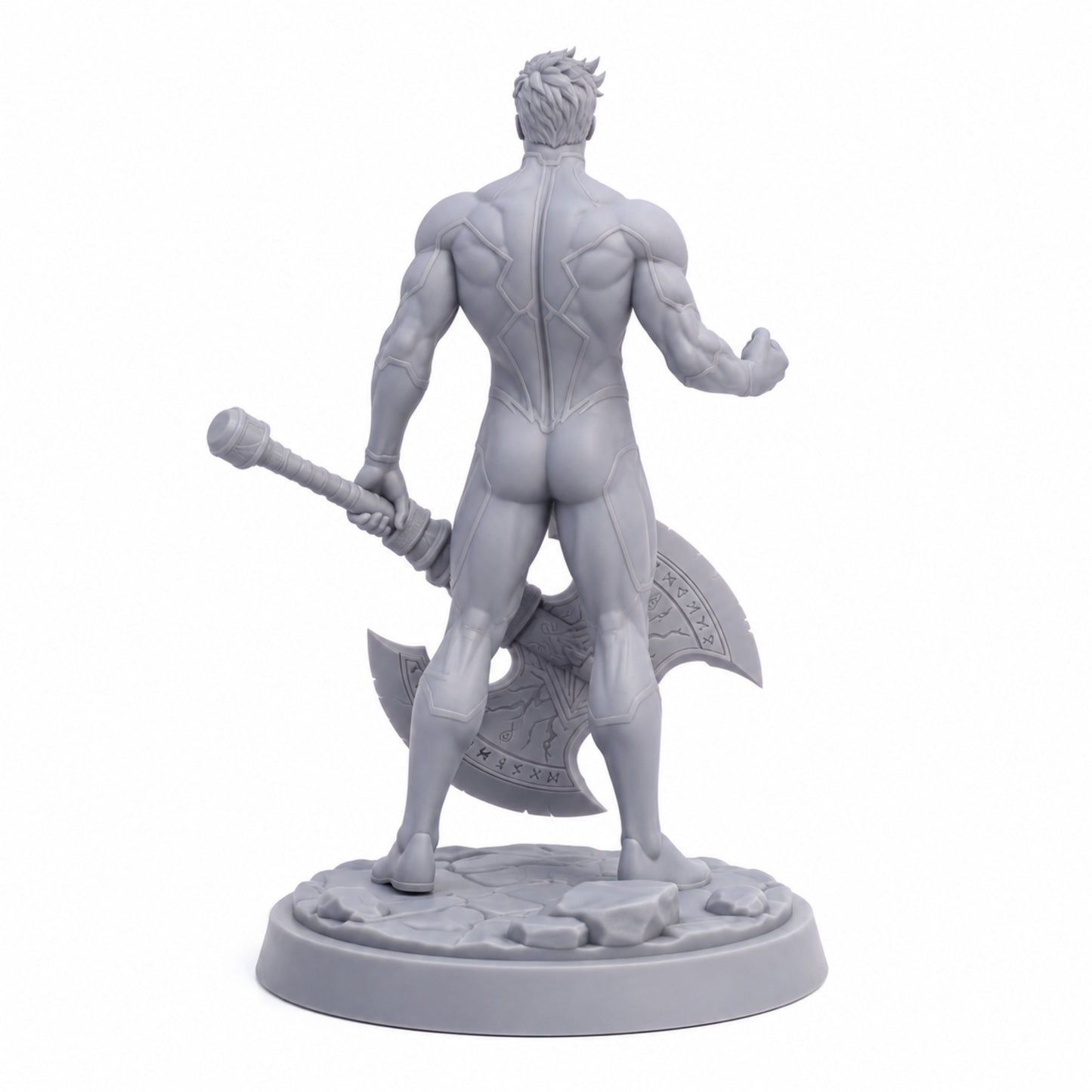
Celebrate Goddark, the Great Architect of All Sapiens and Architect of Tzion, with a detailed miniature from multiverse-Z. His commanding stance, ornate double-bladed axe and distinctive armour make him a memorable addition to a fantasy collection or role-playing table.
You receive one 38 mm physical miniature, professionally 3D printed in premium, high-quality resin and supplied unpainted. The scenic rocky base shown is included. Paint Goddark yourself to recreate the reference finish or give him a colour scheme of your own.
- Included: 1 Goddark miniature with his double-bladed axe and sculpted scenic base.
- Height: 38 mm.
- Material: premium, high-quality resin.
- Production: professional resin 3D printing.
- Finish supplied: unpainted.
- Ideal for: miniature painting, fantasy role-playing games and display collections.
The eight images below show the same single miniature from different angles. Four are painted references and four show unpainted resin. Painted finishes are for inspiration only; painting is completed by the customer.
Goddark — The Great Architect of All Sapiens
Bring the presence of the Great Architect to your collection. Goddark stands with one fist clenched and an immense double-bladed axe held across his body, his swept white hair and stern expression completing the heroic silhouette. The painted reference combines white armour with fine gold borders for a striking interpretation of this figure from multiverse-Z. Painted reference only. Supplied unpainted.

The Great Architect — Unpainted Resin
The front resin view reveals the sculpt beneath the colour: defined anatomy, angular armour lines and an elaborate axe covered in decorative symbols. This is one physical Goddark miniature, supplied unpainted so you can choose the palette and finish. The sculpted rocky base shown is included. Unpainted resin view. Painting is to be completed by you.

The Axe of Destiny — Painted Detail
From this angled view, the scale of Goddark’s axe becomes the focus. Its sweeping blades, engraved motifs and decorated shaft give painters a distinctive centrepiece to work on. Follow the white-and-gold reference or explore contrasting metals and darker recesses to emphasise the weapon’s layered design. Painted reference only. Supplied unpainted.

Armour and Weapon — Unpainted Side View
This resin perspective shows the relationship between Goddark’s stance, his gripping hand and the long axe shaft. Fine borders across the armour contrast with broad surfaces suited to smooth shading. The weapon offers plenty of opportunities for precise highlights and careful work around the engraved details. Unpainted resin view. Painting is to be completed by you.

A Heroic Silhouette from Above
The elevated painted view brings the axe, shoulders and rocky base together in one composition. It offers a useful reference for planning where the brightest highlights will fall, from the raised hair to the upper blade edges, while keeping the white and gold finish consistent across the figure. Painted reference only. Supplied unpainted.

Sculpted Detail — Elevated Resin View
Viewed from above in grey resin, the blade decoration and cracked stone beneath Goddark’s feet are easy to examine. The textured ground gives you room for natural stone colours, subtle weathering or a palette chosen to suit your display. This is another view of the same single miniature. Unpainted resin view. Painting is to be completed by you.

Goddark from Behind — Painted Reference
The rear view shows the continuation of the armour’s geometric borders across the back and legs, together with the sculpted hair and reverse of the axe. Use it to plan a cohesive finish around the entire figure, whether you follow the reference colours or develop your own interpretation. Painted reference only. Supplied unpainted.

The Complete Sculpt — Unpainted Rear View
The final resin view completes your look around Goddark, highlighting his back, armour contours and rocky base. A rewarding subject for miniature painting, fantasy role-playing adventures and display collections, the Great Architect offers a strong silhouette and a detailed weapon to bring to life with your brush. Unpainted resin view. Painting is to be completed by you.

One Goddark miniature and its scenic base are included. The miniature is supplied unpainted; painted images are reference only.
Tap the image below to experience the story as an immersive audiobook, or simply scroll down and enjoy reading it at your own pace. The choice is yours.👇👇👇👇👇

GODDARK; The Architect of Tzion
In the days following their first kiss, Genesis discovered that love did not arrive only as fire.
Sometimes, it arrived as attention.
It lived in the way Kronos slowed his steps whenever she wished to remain a little longer beneath the trees. In the way he listened to her questions without turning every answer into a lesson. In the way his hand reached towards hers and then stopped, allowing her to be the one who crossed the final distance.
Once, he had created stars without asking their permission to burn.
With her, he asked permission for everything.
Genesis noticed.
She noticed that he no longer entered a room without searching for her first. That when she spoke, his gaze remained upon her even if the mountains trembled beyond the windows. That whenever the sorrow within him began to draw him away, some small gesture from her—a smile, a raised eyebrow, the silent brush of her fingers against his arm—could bring him back.
And Kronos, although he still did not know how to confess it, had begun to measure eternity differently.
Before Genesis, eternity had been something he endured.
Now it was something he desired.
Not for himself.
For them.
There were still moments when they were Magister and Prenova. He continued to instruct her in the laws of Tzion, in the discipline of the Kun Arts, in the forging of Proferrum, and in the responsibilities of power. Genesis continued to challenge him, continued to contradict him, continued to become furious whenever he answered a simple question with a riddle designed to force her to reach understanding for herself.
But something had changed beneath it all.
The distance between them was no longer empty.
It was alive.
It held memories of moonlight, shared breaths, and the first impossible moment in which neither creator nor creation had existed between them.
Only a man.
Only a woman.
Only a choice.
Pegaso seemed to understand it before either of them did.
The celestial horse had developed the habit of watching Kronos whenever he approached Genesis. He would remain perfectly still, his white body shining beneath the skies of Urkulo, his blue eyes following the Architect with an intelligence that rendered all pretence useless.
One morning, when Kronos extended a hand to help Genesis climb onto Pegaso’s back, the horse moved sideways before their fingers could touch.
Genesis stared at him.
“Pegaso.”
The horse looked away.
Kronos lowered his hand.
“He does not approve of me.”
“He does approve of you,” Genesis said.
Pegaso turned his head and looked directly at Kronos.
Then he moved sideways again.
Genesis covered her mouth, but the laughter escaped her.
Kronos, Architect of Tzion, master of matter and law, regarded the animal with solemn disbelief.
“I created the ground beneath his hooves.”
Pegaso struck that ground once.
“And yet,” Genesis said, “he does not seem impressed.”
“He has become arrogant.”
“He has developed standards of his own.”
Kronos looked at her.
Genesis was still laughing.
There was no reverence in that laughter. No fear. No obedience.
Only joy.
Something softened in his expression.
Pegaso finally allowed Genesis to climb onto his back, but when Kronos approached again, the horse caught the edge of the Architect’s cloak between his teeth and pulled.
Kronos remained motionless.
Pegaso pulled harder.
Genesis laughed until tears appeared in her eyes.
“You could order him to release it,” she said.
“I could.”
“You could make the cloak disappear.”
“Yes.”
“You could stop time around his mouth.”
“I could do that as well.”
“But you will not.”
Kronos looked into Pegaso’s defiant blue eyes.
“No.”
“Why?”
His gaze moved from the horse to Genesis.
“Because love that demands obedience is merely another form of dominion.”
Pegaso released the cloak.
For one heartbeat, no one moved.
Then the celestial horse lowered his head and gently rested his forehead against Kronos’s chest.
The Architect closed his eyes.
His hand rose and rested between the animal’s ears.
Genesis watched them, and something within her trembled with a tenderness so profound that she did not know how to contain it.
She had seen Kronos raise mountains.
She had seen him shape metal with a thought.
She had heard his voice pass through the foundations of Urkulo like thunder through the bones of the world.
But this was different.
This was not the power to command.
It was the power to restrain himself.
And Genesis understood, perhaps for the first time, that she had not fallen in love with Kronos because he was powerful.
She had fallen in love with the part of him that power had failed to corrupt.
Pegaso raised his head and moved towards her.
Genesis leaned forwards until their foreheads touched.
No words passed between them, and yet she felt the animal’s affection flowing through the bond that united them: immense, serene, and protective. Pegaso did not belong to her. He never would. The connection between them was not possession.
It was mutual recognition.
He had chosen her.
Just as she had chosen Kronos.
“Where are we going?” she asked.
Kronos looked towards the distant mountains.
“To a place you must see.”
Pegaso folded his forelegs and lowered himself slightly.
Genesis extended one hand towards Kronos.
The Architect regarded her.
“Does he permit it?”
“We are about to find out.”
Kronos took her hand and climbed behind her.
Pegaso slowly turned his head.
For several uncomfortable seconds, the Supreme horse stared at him.
Then he exhaled through his nostrils and rose.
“I believe that was consent,” Genesis said.
“That was tolerance.”
“For today, perhaps that is the greatest honour you will receive.”
Pegaso began to run.
At first, his hooves struck the dark earth of Urkulo. Then, without slowing, he left the ground and continued forwards through the open sky.
No wings unfolded from his body. Pegaso had no wings, and he did not need them. Flight was an innate power of his celestial nature, as natural to him as running was to an ordinary horse. It was not a spell, nor an ability granted by Kronos or Genesis. The air itself yielded beneath his hooves, allowing him to gallop across the heavens, climb towards the clouds, descend through the wind, or remain suspended above the world whenever he wished.
Pegaso did not fly by beating wings. He flew because the sky recognised him as one of its own.
With long, effortless strides, he carried Genesis and Kronos above the forests, rivers, and valleys of Urkulo.
Genesis felt the wind passing through her hair.
Kronos sat behind her, one arm resting carefully around her waist. He did not hold her as one protects a possession, but as someone afraid of disturbing a miracle.
Genesis placed her hand over his.
His arm tightened around her body.
Pegaso carried them higher.
Far below, Urkulo unfolded in all its primeval splendour. Silver rivers wound between the mountains. Forests spread across the land like immense dark oceans. Great plains waited in silence for the arrival of feet that had not yet been born. No city rose upon them. No road crossed them. No tower challenged the sky.
The world was unfinished.
It was beautiful because it was unfinished.
Pegaso descended upon the highest ridge of a mountain whose summit rose above the clouds. His hooves touched the black stone, and he stopped before the edge.
Kronos dismounted first.
This time, when he offered his hand to Genesis, Pegaso did not move away.
Genesis accepted it.
As soon as her feet touched the stone, Kronos walked towards the precipice. He raised one hand, and the clouds before them began to divide.
Beyond them, the future appeared.
Genesis had witnessed visions before.
None had prepared her for this.
Urkulo changed before her eyes.
The forests withdrew. Roads appeared. Great cities rose across the plains, their towers built from stone, crystal, metal, and living light. Bridges crossed the valleys. Temples crowned the mountains. Vessels sailed through the skies.
Then the vision expanded.
Urkulo became one world among many.
Planets revolved around distant suns. Oceans shone beneath alien moons. Civilisations appeared and vanished. Races Genesis had never imagined raised kingdoms, fought wars, composed songs, loved, suffered, built monuments, and buried their dead.
She saw children opening their eyes beneath unknown stars.
She saw warriors kneeling before ruined cities.
She saw healers working through the night.
She saw tyrants placing crowns upon their own heads.
She saw ordinary people embracing while entire worlds trembled around them.
The lives passed too quickly for her to understand them, yet she felt the weight of every one.
Millions.
Billions.
More.
The vision widened until the sky itself seemed to be made of living stories.
Genesis took a step backwards.
Pegaso immediately positioned himself behind her. His warm body halted her retreat, and his muzzle brushed her shoulder.
Kronos lowered his hand.
The future disappeared.
Only Urkulo remained.
Silent.
Still unborn.
Waiting.
For a long time, Genesis could not speak.
Kronos did not hurry her.
“You called me Queen,” she finally said.
Her voice was scarcely more than a whisper.
“I did.”
“I thought I understood what you meant.”
“And now?”
She looked across the empty world.
“Now I understand that I understood nothing.”
Kronos remained beside her.
“You will understand.”
Genesis turned sharply towards him.
“All those worlds?”
“Yes.”
“All those people?”
“If Tzion becomes what we hope it can become.”
“And you expect me to rule them?”
“No.”
The answer came without hesitation.
Genesis stared at him.
Kronos looked back towards the horizon.
“I expect us to protect their right to become whatever they choose to be.”
“Is that not ruling?”
“It can be. But it can also become something far more dangerous.”
“What?”
“Possession.”
The word passed coldly through her.
“A Universe does not belong to its rulers,” Kronos continued. “Its rulers belong to the Universe. A crown is not proof that everything beneath it belongs to you. It is a promise that you will carry what others should never be forced to bear alone.”
Genesis lowered her gaze towards her hands.
She remembered those hands emerging from the clay of the Ex-Codice.
She remembered the cold.
The confusion.
The terrible helplessness of awakening beneath the gaze of the being who had decided that she would exist.
She had not chosen that first breath.
She had not chosen her first form.
She had not chosen the name imposed upon her.
And now that same being spoke of placing a Universe upon her head.
“I cannot do it,” she whispered.
Kronos did not contradict her.
“I know.”
The gentleness of those words hurt her more than denial would have.
Genesis looked at him.
“You know?”
“I know that you cannot do it today.”
“And what if I never can?”
“Then you will not.”
She searched his face for disappointment.
She found none.
“You would allow me to refuse it?”
“I would defend your right to refuse it.”
“Even if Tzion needs a Queen?”
“Tzion does not need a prisoner wearing a crown.”
The wind moved between them.
Behind Genesis, Pegaso settled upon the stone. His white body formed a living wall behind her, warm and steady.
“When you called me the future Queen of Tzion,” she said, “I accepted.”
“You trusted me.”
“I did not understand.”
“Then your answer was incomplete.”
“Does that mean it meant nothing?”
“It means you are free to answer again.”
Genesis studied him.
“Would you let me leave?”
Kronos’s eyes changed.
For the briefest instant, the god disappeared, and only the wounded man remained.
“Something inside me would break,” he said. “But yes.”
She felt the truth in his words.
He did not pretend that her departure would not destroy him. He did not hide the pain behind a mask of nobility. He simply refused to use that pain as a chain.
Genesis stepped closer.
“You created me.”
“Yes.”
“You gave me this body.”
“Yes.”
“You placed a name within my first moment.”
“I did.”
“Then how can you know that anything I feel for you is truly mine?”
Kronos did not answer immediately.
Perhaps because no answer could erase what had happened between them at the beginning.
When he finally spoke, his voice had lost all authority.
“The first act of your life was my decision, not yours.”
Genesis held his gaze.
“I cannot change that,” he continued. “I cannot return to that moment and ask whether you wished to be born. Creation allows no such mercy. I took the clay of the Ex-Codice, gave it form, and called you into existence because I believed Tzion needed its first living soul.”
“And because you were alone?”
Pain crossed his face.
“Yes,” he said.
His honesty struck her.
“Loneliness was part of that act. So was hope. So was pain. I will not insult you by pretending otherwise.”
Genesis looked away.
Kronos did not try to touch her.
“I have wondered,” she admitted, “whether you created me to fill an emptiness.”
“I feared you would.”
“Did you?”
“No.”
“How can you be certain?”
“Because you did not fill it.”
Genesis looked at him again.
Kronos’s eyes were wet, although no tears had yet fallen.
“You transformed it,” he said. “You did not become what was missing. You revealed that I had been wrong to believe another being should exist solely to complete me.”
He took a step towards her, but still did not touch her.
“I shaped your body, Genesis. I did not shape your loyalty. I awakened your mind, but I did not decide what it would believe. I gave you a voice, and from the beginning, you used it to oppose me.”
Despite herself, the corner of her mouth rose.
“Often.”
“Relentlessly.”
“You were frequently wrong.”
“I was almost never wrong.”
Pegaso released a low sound behind them.
Genesis looked at the horse.
“Pegaso disagrees.”
“Pegaso has been corrupted by your influence.”
The horse pushed Kronos with enough force to make him retreat half a step.
Genesis laughed.
This time, Kronos laughed with her.
It was not the measured smile of an Architect. It was a spontaneous, unguarded sound, brief and surprised, as though joy had escaped him before dignity could stop it.
Genesis had never heard anything more beautiful.
When the laughter faded, she crossed the final distance between them.
“Did you create me to laugh at you?”
“No.”
“Did you teach me to defy you?”
“Certainly not.”
“Did you place my love for Pegaso inside me?”
“No.”
“Did you command me to kiss you beneath the moons?”
Kronos’s gaze descended towards her lips.
“No.”
Genesis raised her hand and placed it against his chest.
Beneath her palm, his heart was beating.
“You created the place where my choices could begin,” she said. “But the choices are mine.”
Kronos covered her hand with his.
“They must always be yours.”
“Then listen to one of them now.”
He waited.
“I love you.”
The words did not resound like thunder.
No mountain moved.
No light crossed the heavens.
And precisely because nothing in creation changed, the truth felt greater still.
Genesis continued.
“I do not love you because you created me. Sometimes, I love you despite the fact that you did.”
Kronos closed his eyes.
It was not the declaration he might once have dreamed of hearing.
It was better.
It was free.
“And I do not want a throne because you chose it for me,” she said. “I do not want people to kneel because I was the first among them. I do not want a crown that makes me superior to the lives you showed me.”
“Neither do I.”
“But if that crown means placing myself between those lives and the powers that will try to devour them…”
Her fingers tightened over Kronos’s heart.
“If it means carrying that weight beside you…”
Kronos opened his eyes.
“If it means that neither of us will ever have to become a god alone…”
She looked towards the horizon.
“Then I will learn.”
Something inside Kronos broke.
Not from pain.
From release.
He lowered his head until his forehead rested against hers.
“You will not stand behind me,” he whispered.
“No.”
“You will not kneel before me.”
“Never.”
“You will not become my reflection.”
Genesis smiled.
“One of you is already difficult enough to endure.”
A breath of laughter passed between them.
Kronos raised his head.
“You will stand beside me,” he said. “Not because I created you. Not because Tzion demands it. Not because destiny has written your name upon a throne.”
“Then why?”
“Because every day, knowing more than you knew the day before, you continue to choose it.”
Genesis looked into his eyes.
“And you?”
“I will be the first King of Tzion if a king is what its people one day need to call me. But Architect, King, god… None of those names matter beside the promise.”
“What promise?”
“That you will never carry the crown alone.”
Genesis felt the immensity of the future again.
This time, it did not crush her.
It was still immense. It was still terrifying. She still did not know how a woman who had once opened her eyes in cold clay could become the mother of civilisations, the guardian of worlds, or the First Queen of a Universe.
But she no longer believed that courage meant feeling ready.
Perhaps courage was simply refusing to flee from what mattered merely because one was not yet prepared.
“Then we will learn together,” she said.
“Together.”
“And if one of us falls?”
“The other will hold them.”
“And if we both fall?”
Kronos looked towards Pegaso.
The celestial horse raised his head.
“Then he will be unbearably pleased with himself for saving us.”
Pegaso rose and pushed his muzzle between them.
Genesis wrapped her arms around his neck. Kronos rested one hand upon the horse’s face, and for a moment they remained like that: the future Queen, the future King, and the sublime companion who belonged to neither of them and yet had chosen them both.
There was no throne.
No court.
No crown.
Only a promise spoken upon a mountain before the birth of Tzion’s first kingdom.
And perhaps that was how every worthy kingdom should begin.
Not with conquest.
With trust.
They remained upon the summit until Urkulo’s sun descended.
Pegaso carried them back through a sky slowly changing from gold to violet. He required neither wings nor incantations to keep them above the world. Each movement through the air was merely another expression of the innate celestial power within him. He galloped across the empty sky as naturally as other horses ran across the earth, and the invisible paths of the heavens formed beneath his hooves wherever he chose to go.
This time, Kronos sat closer. Genesis rested against him, and his arms encircled her without hesitation.
She could feel his breath close to her ear.
For a time, neither of them spoke.
Pegaso moved beneath them with such a serene rhythm that Genesis’s eyes began to close.
She did not fall asleep.
She listened.
Kronos’s heart beat steadily against her back, but his thoughts possessed no such calm. She could sense the change that came over him as the skies darkened. It was as though every sunset opened a door within him that he spent his days keeping closed.
She had noticed it before.
Now she understood that love did not grant her the right to force that door open.
But it gave her the courage to wait beside it.
When they returned, Genesis removed her Proferrum sword and left it near the entrance. Kronos made the remains of his cloak—still marked by Pegaso’s teeth—begin to disappear, but Genesis caught the fabric before it vanished.
“Leave it.”
“It is damaged.”
“So are many things worth preserving.”
Kronos looked at her.
Genesis carefully folded the cloak and placed it beside her sword.
Pegaso settled upon the nearby grass. Although he needed no protection against the cold, he lay close enough for Genesis to rest against his side.
Kronos sat beside her.
Genesis rested her head upon his shoulder.
An Architect who had once held the first laws of Tzion within his hands remained completely motionless, afraid that the smallest movement might disturb her.
Genesis smiled without opening her eyes.
“You can breathe.”
“I am breathing.”
“Like a man awaiting judgement.”
“I have faced less dangerous judges.”
She opened one eye.
“Than me?”
“Than Pegaso.”
The horse’s ear turned towards him.
“Be careful,” Genesis whispered. “He is listening.”
“I know.”
The night deepened.
Within Genesis, Polaris remained unusually silent. The Pioneer was never entirely absent, but she seemed to understand that there were moments when even a soul sharing another soul must retreat into stillness.
Genesis took Kronos’s hand.
His fingers closed around hers.
“When you become silent,” she said, “where do you go?”
Kronos looked at the stars.
“I remain here.”
“That is not what I asked.”
“No.”
She waited.
The old Kronos would have answered with a lesson. He might have transformed the question into a teaching about patience, memory, or the discipline of the mind.
This time, he did not.
“I go backwards,” he said.
“How far?”
“Beyond Urkulo. Beyond your birth. Beyond the first life of Tzion.”
Genesis raised her head from his shoulder.
“Towards Primo?”
Kronos’s hand became motionless between hers.
The silence changed.
Pegaso raised his head.
Genesis felt that she had touched the edge of something buried so deeply that even the world around them had learned to avoid it.
Kronos did not look at her.
“You have heard that name.”
“Only from you.”
“When?”
“Sometimes, when you believe I am asleep.”
Kronos lowered his gaze.
“You do not speak it with anger,” Genesis continued. “I think anger would hurt you less.”
“What do you hear?”
“A tomb.”
His jaw tightened.
“Yes.”
“Who was he?”
For a long time, the only answer was the wind moving through Pegaso’s mane.
Then Kronos spoke.
“My brother.”
Genesis had expected him to say enemy.
She had expected him to say monster.
She had not expected brother.
“Was he truly your brother?”
“As much as any being has ever been.”
“What happened to him?”
Kronos looked at their intertwined hands.
“I happened to him. And he happened to me.”
“That is not an answer.”
“It is the only answer I have been able to survive.”
Genesis moved in front of him.
Kronos tried to turn his face away, but she touched his cheek.
He stopped.
“You do not have to tell me tonight,” she said.
“Then why do you ask?”
“So that you know I can see the wound.”
His eyes met hers.
“You hide it well from the Universe,” Genesis continued. “But you cannot hide it from me.”
“Perhaps I wanted you to see it.”
“Perhaps.”
“And what if what you see changes the way you look at me?”
“Then at least I will be looking at you. Not at the god who pretends he has never suffered.”
A tear gathered in his eye.
Genesis did not wipe it away.
She allowed it to fall.
Kronos had created oceans.
That single drop seemed to cost him more.
“Primo did not begin as my enemy,” he said. “He began as the answer to my loneliness.”
Genesis listened.
“I existed before the first star of Tzion. Before Urkulo. Before the matter of this Universe had learned to hold a form. I lived alone in a place called Kokoon, and I believed loneliness was the only burden I could not endure.”
“So you created him?”
“No. I asked for him to be given to me.”
“From whom?”
Kronos hesitated.
The question had reached farther than Genesis understood.
“I was not always Kronos,” he said.
She watched him.
“Kronos is the name I adopted when I entered the material world. It is the name of this body. The name through which I could walk upon Urkulo and speak to you face to face.”
“What were you before?”
The stars were reflected in his eyes.
“Goddark.”
Genesis repeated it softly.
“Goddark.”
The name seemed older than language itself.
It did not sound like Kronos. It did not seem to belong to the man sitting beside her beneath the night sky. It carried the pressure of something far greater, something born before mountains, flesh, or time.
And yet, when Genesis touched his face again, the same soul looked back at her from the other side.
“Does that name frighten you?” he asked.
“No.”
“It should.”
“Why?”
“Because Goddark made decisions whose weight Kronos still carries.”
“Then I will not love one only to turn away from the other.”
“You still do not know what I did.”
“No,” Genesis said. “And I will not forgive what I do not understand merely because I love you.”
Kronos trembled.
“But I can remain beside you while you tell me.”
He closed his eyes.
Genesis moved closer and wrapped her arms around him.
For one terrible heartbeat, Kronos did not respond. His body remained rigid, as though tenderness were a weapon against which he possessed no defence.
Then his arms encircled her.
He held her with a desperation no king would ever have permitted his subjects to witness.
Genesis felt the loneliness of entire ages within that embrace.
She felt the brother he had loved.
The trust that had been betrayed.
The god who had learned to distrust every form of devotion.
The creator who had formed a woman from clay and then begun to fear that her love might be nothing more than another reflection of his own will.
“You are not Primo,” he whispered against her hair.
“No.”
“I know.”
“Do you?”
“I am learning.”
Genesis held him more tightly.
“You do not need to stop being wounded for me to love you.”
His breathing stopped.
“I cannot repair what he did,” she continued. “I cannot return the part of you that died. I cannot promise that knowing everything will never hurt us.”
Kronos’s hand trembled against her back.
“But your wound is not a prophecy,” she said. “I am not destined to betray you merely because someone else did.”
“I once believed love made trust safe.”
“Love does not make anything safe.”
He drew back far enough to look at her.
“Then what does it do?”
“It makes facing the danger with honesty worthwhile.”
For a moment, he merely gazed at her.
Then Kronos kissed her.
There was no urgency in that kiss. No desire to possess. It was a confession made without words, a surrender not of power, but of every defence he possessed.
Genesis answered by placing both hands against his face.
Pegaso lowered his head beside them and sheltered them beneath the long fall of his white mane. His presence did not interrupt the moment.
It completed it.
When their lips parted, Kronos kept his forehead resting against hers.
“I love you,” he said.
Genesis smiled faintly.
“You have travelled a very long way to reach three such simple words.”
“I was born before simplicity.”
“That explains many things.”
A silent laugh escaped him.
Then his expression became solemn once more.
“You asked who Primo was.”
“Yes.”
“To understand him, you must understand where I come from.”
“Kokoon.”
“Before Kokoon.”
“You said you existed before Tzion.”
“Yes.”
Genesis looked upwards.
The stars of Urkulo filled the night. Until that moment, she had believed she was looking upon immensity itself.
Kronos followed her gaze.
“You see the Universe,” he said.
“I see part of it.”
“No. You see almost nothing. But everything you could ever reach by travelling through those stars—every galaxy, every world, every darkness existing between them—all of it belongs to the same Universe.”
“Tzion.”
“Tzion.”
“And you created it.”
“I awakened it. I shaped its laws. I guided its formation.”
Genesis looked at him.
“Is there a difference?”
“There is always a difference between creating something and believing it belongs entirely to you.”
Kronos extended one hand.
Darkness began to gather above his palm.
A sphere appeared.
At first, it was black, smooth, and perfect, like a pearl carved from the night. Then light awakened within it. Galaxies began to revolve beneath its surface. Countless stars burned in depths that should never have been able to exist inside something so small.
Genesis leaned towards it.
“Tzion,” she whispered.
“A representation of Tzion.”
“The entire Universe is inside that sphere?”
“The true vessel is infinitely greater than what you see. But yes.”
Genesis raised one finger, although she did not touch it.
She looked back towards the heavens.
Then she looked at the sphere again.
“Why would a Universe need a vessel?”
Kronos raised his other hand.
A second sphere appeared.
Then another.
And another.
They multiplied around them.
Ten.
A hundred.
Thousands.
Soon, the darkness above Urkulo was filled with them. Immense crystalline orbs floated among the stars, each one containing its own lights, its own galaxies, and its own impossible depths.
Genesis slowly rose.
Pegaso rose with her.
The spheres continued appearing until they formed an immeasurable ocean of Universes.
Genesis turned in every direction.
The sky she had believed infinite had become merely the interior of a single light among innumerable lights.
“What are they?” she asked.
“Other Universes.”
Her voice failed her.
She looked at the sphere of Tzion and then at the endless multitude surrounding it.
“Other… Universes?”
“Yes.”
“With other worlds?”
“Yes.”
“Other forms of life?”
“Some of them.”
“Other Architects?”
“Yes.”
“Other gods?”
“More than Tzion may ever know.”
Genesis involuntarily stepped backwards.
Pegaso pressed his body against hers.
“I thought Tzion was everything.”
“To those born within it, it may appear to be.”
“But it is not.”
“No.”
“What lies beyond all of them?”
“The Astral World.”
“And beyond that?”
“The Source cannot be understood as a place contained within something greater. It is the centre from which the great structure of existence emerges.”
Genesis looked again at the multitude.
“And all of this together?”
“The Universes. Their Antiverses. The Astral World. The Source. The beings who exist above physical creation. The great web connecting every vessel.”
Kronos closed his fingers around the sphere of Tzion.
“All of it is the Cosmos.”
Genesis remained silent.
Kronos watched her carefully.
She had felt overwhelmed while contemplating the future lives of a single Universe. Now she looked upon a reality so immense that Tzion itself had become almost invisible within it.
“And I thought one crown was too great,” she whispered.
Kronos moved closer to her.
“Tzion has not become smaller because other Universes exist.”
“It seems small.”
“One life is small beside Tzion. Does that make it meaningless?”
“No.”
“Then Tzion is not meaningless beside the Cosmos.”
Genesis looked at the sphere he held.
“Is our Universe only one among all of those?”
“One CryptaSphere among countless CryptaSpheres.”
“A needle lost in an endless field.”
“To the Cosmos, perhaps.”
“And to us?”
Kronos placed the sphere of Tzion between their joined hands.
“Our home.”
The word calmed her.
Not kingdom.
Not possession.
Home.
Genesis looked into his eyes.
“Who created you, Goddark?”
The name affected him differently this time.
Not as an accusation.
But as an invitation to stop dividing himself.
“A being called Silke,” he answered. “The Demiurge of the Astral World.”
“Are there beings greater than you?”
“Yes.”
Genesis stared at him.
Kronos almost smiled.
“You appear pleased by that.”
“I have been waiting a very long time to discover something capable of making you humble.”
“Pegaso had already accomplished that.”
The horse struck the ground once.
Genesis laughed softly, but the wonder did not leave her.
“And Primo?”
“He was also born there, although not in the same way as I was. I asked not to be alone, and Silke granted me a reflection.”
“A reflection?”
“Primo was formed from my own essence. My counterpart. My Prenova. My brother.”
“And then?”
The light inside the sphere trembled.
“Then the reflection broke.”
Genesis closed her fingers around his.
“Tell me.”
“There is much to tell.”
“Then tell me everything.”
“If I do, you will never look upon Tzion in the same way again.”
“I do not want to see only what is easy to understand.”
“You may look at me differently.”
“I already do.”
Fear entered his expression.
Genesis raised Kronos’s hand and kissed the centre of his palm.
“Once, I looked at you as my creator,” she said. “Then as my Magister. Then as the man I desired. Then as the man I chose.”
She placed his hand over her heart.
“Now let me see the one who existed before all of them.”
Around them, the vision of the countless CryptaSpheres slowly faded. One by one, the Universes disappeared until only the stars of Urkulo remained.
Pegaso lowered himself onto the grass.
Genesis sat beside him.
Kronos remained standing for a moment, looking upwards, as though he could see beyond Tzion’s stars, beyond the walls of the CryptaSphere, and into the Source itself.
Then he sat beside her.
Genesis rested against Pegaso’s white body. Kronos took her hand and held it between both of his.
For the first time since his birth, Goddark prepared to tell another living soul the whole truth of who he was.
Not as an Architect reciting history.
Not as a Magister delivering a lesson.
Not as a King explaining the foundations of his throne.
As a man opening the oldest wound in his heart to the woman he loved.
“To understand what Primo became,” he said, “you must first understand why I asked for him.”
Genesis waited.
“You must understand the Astral World. The Source. The Astrals. The CryptaSpheres and the great web connecting them. You must understand the difference between a Universe and the Cosmos.”
He looked into her eyes.
“And you must understand that my story did not begin with light.”
Genesis tightened her hand around his.
“I am listening.”
Kronos breathed slowly.
Then, beneath the ancient skies of Urkulo, with Pegaso beside them and the future of Tzion still unborn, Goddark began.
THE COSMOS OF MULTIVERSE-Z
The Source Before All Universes
Before the first star learned to burn, before the first world turned in silence, before time had a name by which mortals could fear it, there was the Astral World.
It was not a kingdom.
It was not a heaven.
It was not a void.
It was the Source.
All things that would ever become real slept there first as impossible thoughts. Every future sea, every unborn sun, every race that would one day rise and fall beneath the burden of memory existed there only as a tremor within an endless spiritual ocean. The Source did not shine like fire, nor did it drown like darkness. It pulsed.
It pulsed like a heart beyond creation.
And from that pulse came the Astrals.
They were not gods as mortals would later understand gods. Gods belonged to Universes. Gods ruled over laws, stars, souls, nations, storms, and destinies. But the Astrals stood above them. They were Meta-Gods, Meta-Architects, beings whose existence preceded the birth of physical reality itself.
They had forms, yet they were not bound by flesh.
They could be seen, yet they could not be touched.
Some appeared with the noble shape of ancient humanoids, crowned with antlers of light or cloaked in rivers of stardust. Others bore the vast shoulders of giants, the sharp elegance of elves, the brutal silhouettes of orcs, or shapes for which no mortal language would ever invent a name. Some were beautiful. Some were terrifying. Some were so strange that even to behold them would have broken the minds of ordinary souls.
Yet all of them were spirits.
Visible. Intangible. Eternal.
And each Astral, according to its essence, its dream, its wound, its beauty, or its hunger, carried within itself the possibility of a Universe.
For Universes were not made from nothing.
They were born from will.
They were conceived in the Source, shaped by the Astrals, and sealed within immense crystalline vessels known as CryptaSpheres.
Each CryptaSphere was a colossal sphere of dark glass, black and silent when first created, vast enough to contain galaxies, ages, wars, civilizations, and the slow sorrow of history. To mortal eyes, such a thing would have seemed infinite. To the Astrals, it was a sacred vessel held between spiritual hands.
At first, every CryptaSphere was dead.
Then came the ignition.
Deep inside its core, something was awakened. A primordial fracture. A divine detonation. A first cry of matter against emptiness. Later, mortal scholars within certain Universes would name this event the Big Bang, believing it to be the beginning of all things.
They were wrong.
It was not the beginning of all things.
It was only the birth of one Universe within one CryptaSphere.
Beyond it, countless others floated in the impossible vastness surrounding the Source, each connected by streams of living energy, each protected, observed, or judged by those who dwelled above creation.
Those streams formed the CryptoWeb.
The CryptoWeb was the great invisible network of the Cosmos, the sacred web that linked every CryptaSphere to the Astral World. Through it flowed memory, judgement, divine command, and the silent supervision of the Meta-Gods.
At the centre was the Source.
Around it turned the CryptaSpheres.
Between them stretched the CryptoWeb.
And all of this together — the Astral World, the Universes, their Antiverses, their gods, their histories, their destinies — was known by the highest beings as the Cosmos.
But among the oldest tongues of the Source, it had another name.
A name spoken with reverence.
A name whispered even by the Astrals.
Multiverse-Z.
Silke, the Demiurge
Above the multitude of Astrals, above even the oldest among the Meta-Gods, there was Silke.
She was the Demiurge.
The Meta-Goddess.
The supreme sovereign of the Astral World.
She was not merely powerful. Power was too simple a word for what she was. Power could destroy, command, bend, or create. Silke was older than power. She was the authority from which power learned its direction.
She ruled the Source not as a tyrant rules a throne, but as gravity rules the stars.
All things moved in relation to her.
All Astrals acknowledged her.
All CryptaSpheres trembled beneath her gaze.
And yet, of all the forms that existed within the Astral World, Silke bore one that would later become the most cherished and most dangerous shape in the Multiverse-Z.
She appeared as a Sapiens woman.
Human in form.
Perfect in proportion.
Terrible in serenity.
Her beauty was not softness, nor vanity, nor ornament. It was balance made visible. Her eyes carried the silence of unborn Universes. Her hair fell like threads of pale cosmic fire. Her face held the calm of one who had witnessed the birth of realities and the collapse of divine empires without ever lowering her gaze.
Because of this, among all the races that would one day awaken inside the many CryptaSpheres, the Sapiens would hold a strange and sacred place.
They were not the strongest.
They were not the oldest.
They were not the wisest.
But they resembled Silke.
And from that resemblance grew mystery, favour, envy, and destiny.
Among the countless Universes, there would be one that carried her deepest attention.
The Universe of Tzion.
The Sapiens Universe.
Not the only great Universe. Not the only powerful Universe. Not the only one capable of glory. But the one upon which Silke would place a gaze more intimate than supervision.
It would be her chosen experiment.
Her beloved risk.
Her most dangerous hope.
Beside Silke stood her two daughters: Scorpio and Virgo.
They were the Meta-Princesses of the Astral World, daughters of the Demiurge, radiant and flawless in their own right. Like their mother, they bore the appearance of Sapiens beings, though no mortal blood ran through them. Their beauty was severe, impossible, and sacred.
Scorpio carried the intensity of judgement. Her gaze could pierce intention before action had been born. She saw fractures before they became wounds, ambition before it became rebellion, devotion before it became sacrifice.
Virgo carried the harmony of structure. She understood balance, proportion, patience, and the sacred architecture of becoming. Where Scorpio sensed danger, Virgo sensed design.
Together, the daughters of Silke watched over the shaping of many realities.
But when the time came for Tzion, even they understood that this creation would not be ordinary.
The Demiurge herself had turned toward it.
And when Silke turned toward a Universe, all the Source became silent.
The Dark Vessel of Tzion
The creation of a Universe did not begin with light.
It began with darkness.
In the deep expanses surrounding the Source, where the CryptoWeb shimmered like veins of golden energy through the spiritual void, the Astrals gathered. They came not in crowds, for such beings did not gather as mortals gathered. They arrived as presences. As lights. As shadows. As colossal silhouettes reflected upon the skin of eternity.
At the centre of their attention floated a newborn CryptaSphere.
Black.
Silent.
Unawakened.
It was immense beyond mortal imagining, yet within the hands of the Astrals, it seemed almost delicate. Its surface was smooth like obsidian glass, but beneath that darkness there were depths no eye could measure. No stars shone within it yet. No planets turned. No souls dreamed. No laws had been written.
It was possibility without breath.
This was the vessel that would become the Universe of Tzion.
Silke stood before it, and the darkness of the CryptaSphere reflected her face.
For a long while, she said nothing.
Scorpio and Virgo stood behind her, each watching the vessel with different thoughts.
“Mother,” said Virgo, her voice gentle but filled with reverence, “the vessel is stable. Its inner shell accepts the future division.”
Scorpio narrowed her eyes. “Its darkness is unusually deep.”
Silke did not turn. “Because its light will be unusually difficult.”
Neither daughter answered.
The Demiurge raised one hand, and threads of force began to descend from the Source. They did not look like lightning, nor fire, nor water, though they carried something of all three. They were spiritual commands, woven into visible energy.
They touched the surface of the CryptaSphere.
The black glass trembled.
Then Silke spoke the first law of Tzion.
Not in words that mortals could have understood.
Not in language.
In authority.
The CryptaSphere opened inward.
No crack appeared upon its surface. No wound marked its perfect shell. Instead, the vessel accepted the command and formed a hidden interior division, an unseen spiritual depth that would become the inner soul of the Universe.
For every true Universe possessed two realities.
The physical Universe.
And the Antiverse.
The physical Universe would become the body: matter, galaxies, stars, worlds, elements, flesh, blood, oceans, mountains, civilizations.
The Antiverse would become the soul: hidden, invisible to ordinary matter, yet essential to the destiny of everything born within the CryptaSphere.
The Antiverse of Tzion would have a name.
Kokoon.
It would be the secret chamber of divine consciousness.
The inner sanctuary.
The place where the Architect of Tzion would awaken.
For no Universe could govern itself at birth. Each required a divine mind, a god appointed by the Astrals, an Architect who would reside within its Antiverse and guide its unfolding laws.
And so, before Tzion could ignite, its Architect had to be created.
The Birth of Goddark
From the hands of Silke, a figure began to form.
At first, he was only light inside darkness.
Then breath without lungs.
Then thought without memory.
Then shape.
Scorpio watched in silence.
Virgo bowed her head.
The being who emerged before the dark CryptaSphere looked like a perfect human male, though no human yet existed anywhere in Tzion, for Tzion itself had not yet been born. His hair was white, not with age, but with the purity of first creation. His eyes were blue, deep as newborn skies imagined before skies existed.
His face was noble, calm, and severe.
He opened his eyes.
For the first time, Goddark became aware of himself.
He did not gasp. He did not cry out. He did not tremble like a mortal child. Yet something within him moved with the terror of awakening.
He saw Silke.
He saw Scorpio.
He saw Virgo.
He saw the black CryptaSphere behind them, immense and silent.
And though he did not yet understand language, he understood purpose.
He had not been made to exist.
He had been made to create.
Silke stepped closer.
“You are Goddark,” she said. “You are the Architect of Tzion. Within this vessel, a Universe will awaken. Its laws will require your mind. Its matter will require your command. Its future will require your judgement.”
Goddark looked upon the CryptaSphere.
Inside its darkness, he felt a vast unborn pressure.
Galaxies waiting to unfold.
Planets waiting to harden.
Life waiting to suffer.
Souls waiting to ask why they had been made.
“Will I be alone inside it?” he asked.
It was his first question.
And because it was his first question, Silke remembered it.
For a moment, neither Scorpio nor Virgo spoke.
Then Virgo answered with kindness. “An Architect is singular. A Universe requires one divine centre.”
“One will,” said Scorpio. “One judgement. One throne.”
Goddark listened, but his gaze did not leave the dark vessel.
“One throne,” he said quietly, “may still be lonely.”
A strange silence followed.
The Astrals who watched from the distant reaches of the Source stirred with faint unease. It was not common for a newborn Architect to speak of loneliness before command. Most awoke with hunger for creation, with awe, with obedience, with solemn acceptance.
But Goddark had awakened with need.
Silke studied him.
In that first exchange, she perceived both greatness and danger.
A god who understood loneliness might create with compassion.
A god who feared loneliness might one day create from wound.
“Enter Kokoon,” said Silke at last. “There you will learn. There you will wait. There you will become worthy of Tzion.”
The surface of the CryptaSphere shimmered.
An unseen passage opened.
And Goddark, first Architect of Tzion, entered the soul of his unborn Universe.
The Centuries of Kokoon
Time did not pass inside Kokoon as it would later pass inside the physical Universe.
There were no suns to mark days.
No moons to measure longing.
No seasons.
No death.
Yet duration existed.
And Goddark endured it.
For centuries beyond mortal counting, he dwelled within the Antiverse of Tzion, surrounded by a silence so vast that even his thoughts seemed to echo. Kokoon was not empty, but it was unfinished. Its spaces were formed from spiritual potential. It contained halls that were not built, skies that were not above, oceans that had no water, and horizons that curved inward toward the mind of the Architect.
There, Silke instructed him.
Not always directly. Sometimes her presence came as light. Sometimes as law. Sometimes as silence pressing upon him until he understood what speech could not teach.
Virgo taught him structure.
She showed him how gravity could become loyalty between bodies. How matter could gather without collapsing into chaos. How symmetry could exist without stagnation. How beauty was not decoration, but the visible trace of balance.
Scorpio taught him judgement.
She showed him that creation without consequence was cruelty. That freedom without boundary became ruin. That power, when untested, always imagined itself innocent.
And Goddark learned.
He learned the foundations of physics before physics existed.
He learned how stars could be born from collapse, how worlds could be sculpted by violence, how life could arise from fragile combinations of heat, pressure, water, mineral, and impossible chance.
He learned that every living race would eventually ask its creators for mercy.
He learned that mercy was never simple.
He learned that justice could wound.
He learned that love could corrupt.
And through all his learning, he remained alone.
At first, he carried that loneliness with discipline. He buried it beneath study. He turned it into patience. He told himself that an Architect must not desire comfort. He told himself that a Universe was not created for the happiness of its god.
Yet centuries became millennia.
Millennia became a silence without edge.
And still the CryptaSphere waited.
Still Tzion had not ignited.
Still Goddark walked the hidden expanses of Kokoon without another mind beside him.
He began to speak to unborn stars.
He gave names to galaxies that did not yet exist.
He imagined voices.
He imagined disagreement.
He imagined laughter.
This concerned Virgo.
It troubled Scorpio more.
From the Source, the daughters of Silke watched the CryptaSphere of Tzion through the luminous strands of the CryptoWeb.
“He is becoming too inward,” said Scorpio.
“He is becoming deep,” said Virgo.
“Depth and fracture are often neighbours.”
Virgo did not deny it.
So they went to Silke.
The Demiurge listened as her daughters spoke. She already knew what they would say, for nothing within Tzion had escaped her attention.
“He desires a companion,” said Virgo.
“He desires a mirror,” said Scorpio. “That is more dangerous.”
Silke remained silent for a long time.
Then she looked through the CryptoWeb and saw Goddark alone inside Kokoon, standing before the unborn map of his Universe, one hand raised toward stars that did not yet burn.
“He was made in my image more closely than most Architects,” said Silke. “Perhaps that is why he feels absence so sharply.”
“An Architect should be one,” said Scorpio.
“Yes,” said Silke. “That is the law.”
“Then we should deny him.”
Silke turned toward her daughter.
“Laws exist because reality requires stability. But creation is not only stability. Sometimes a Universe becomes great because one dangerous exception is permitted.”
Virgo lowered her gaze. “You would allow it?”
“I will consider it.”
Scorpio looked again toward the dark CryptaSphere.
“Then we must keep our eyes upon them.”
“Yes,” said Silke. “We will.”
The Mirror Granted
When Silke appeared again inside Kokoon, Goddark knelt.
He had grown in wisdom. Not in age, for gods do not age as mortals do, but in weight. His eyes had become deeper. His silence had become more disciplined. Yet beneath his composure, Silke saw the wound clearly.
“You have learned much,” she said.
“I have learned what I can alone.”
“And what do you believe you cannot learn alone?”
Goddark raised his eyes.
“Opposition.”
Silke studied him.
He continued.
“I can study law, but without another will, I cannot understand conflict. I can design justice, but without another voice, I cannot test mercy. I can imagine creation, but imagination that never meets resistance may become pride.”
Those words pleased Virgo, who stood beside her mother unseen by Goddark.
They did not please Scorpio.
“And what do you ask?” said Silke.
“A counterpart,” said Goddark. “Not a servant. Not a lesser spirit. Not a shadow without thought. I ask for a second face. A reverse. A companion who can stand before me and answer.”
The air of Kokoon became still.
“To divide the authority of an Architect is perilous,” said Silke.
“I do not ask to divide the throne.”
“No,” said Silke. “You ask to divide yourself.”
That truth struck him more deeply than rebuke.
For a moment, Goddark said nothing.
Then he bowed his head.
“Yes.”
The decision that followed would be remembered in the Astral World as one of the first great anomalies of Tzion.
Silke, sovereign of the Source, permitted the duplication.
Under the supervision of Scorpio and Virgo, the essence of Goddark was drawn outward from him, not stolen, not severed, but reflected. A second divine pattern formed from the first. The symmetry was perfect and yet not identical, for no reflection is ever innocent.
Light bent.
Darkness answered.
The shape of a second being emerged.
He had the face of Goddark.
The height of Goddark.
The divine structure of Goddark.
But his hair was black.
Not merely dark, but black like the untouched surface of a dead CryptaSphere before ignition. His eyes opened with a brilliance that was not blue sky, but the sharp gleam of hidden depths.
He looked at Goddark.
And Goddark looked back.
For the first time since his birth, the Architect of Tzion was not alone.
Silke spoke.
“You are Primo.”
The newborn being turned toward her.
“You are not the Architect of Tzion. That authority belongs to Goddark. But you are born from his essence, permitted by my command, and placed within Kokoon as his counterpart, his student, and his mirror.”
Primo listened.
There was curiosity in him.
There was wonder.
There was also something else.
A flash too brief for Virgo to name.
A sharpness that Scorpio did not miss.
Goddark approached him slowly.
“Brother,” he said.
The word had not existed in Kokoon until that moment.
Primo smiled.
“Magister,” he answered.
And so began the age of two faces within the soul of Tzion.
Magister and Prenova
The relationship between Goddark and Primo did not begin as rivalry.
It began with wonder.
To Primo, everything was new. Kokoon itself astonished him. The unborn architecture of the Universe of Tzion, which Goddark had studied for ages, appeared to Primo as a limitless miracle. He walked through halls of spiritual geometry and asked questions without restraint. He touched maps of future galaxies and laughed when they shifted beneath his fingers.
Goddark watched him with a feeling he had not known before.
Joy.
Not the joy of triumph. Not the joy of command. Something gentler. Something dangerous precisely because it softened him.
He became Magister.
Primo became Prenova.
And inside Kokoon, the first master-apprentice bond of Tzion was born.
Goddark taught him creation.
He showed Primo how thought could become law, how law could become force, how force could become matter. He explained the patience required to shape a stable galaxy, the precision needed to balance light and gravity, the ethics of allowing life to struggle without abandoning it entirely.
“Creation is not possession,” said Goddark.
Primo listened, though not always patiently.
“Then why create at all,” he asked, “if what is made does not belong to the maker?”
“Because creation is responsibility.”
“Responsibility sounds like a chain.”
“It is.”
“Then why do you accept it?”
Goddark looked toward the sleeping physical Universe beyond the veils of Kokoon.
“Because without it, power becomes empty.”
Primo considered this.
Then he smiled slightly.
“Or free.”
Such moments disturbed Scorpio.
From the Source, she watched them often. Through the CryptoWeb, she observed their training, their debates, their silences. She saw the brilliance in Primo, but brilliance did not reassure her.
Fire was brilliant.
So was a blade.
Virgo, however, saw promise.
“They challenge one another,” she told Silke. “Goddark grows less solitary. Primo learns quickly. Their symmetry may strengthen Tzion.”
“Or split it,” said Scorpio.
Silke listened to both.
She did not intervene.
Not yet.
For Goddark remained wise. His authority held. His compassion deepened. His patience, once born from solitude, now became active instruction. He corrected Primo when needed, but he did not humiliate him. He allowed questions. He welcomed disagreement. He believed that if Primo had been born from his own essence, then any darkness within the mirror could be guided by the original light.
This belief was noble.
It was also the beginning of his blindness.
The First Designs of Tzion
After long ages of preparation, the time came.
The CryptaSphere of Tzion could not remain dark forever. Its inner laws had been written. Its Antiverse, Kokoon, had stabilized. Its Architect had matured. Its counterpart had been trained. The vessel was ready to receive ignition.
The Astrals gathered once more.
The CryptoWeb brightened around the unborn Universe, strands of living energy tightening like golden veins around a sacred heart. Across the Source, presences turned toward Tzion. Some watched with admiration. Some with curiosity. Some with envy.
The Sapiens Universe was about to awaken.
Inside Kokoon, Goddark stood at the centre of the inner throne-space, though no throne had yet been built. Around him floated the first design-patterns of reality: spirals of galaxies, deep oceans of nebulae, planetary seeds, laws of motion, chemical possibilities, evolutionary paths, and spiritual thresholds through which future souls might one day rise.
Primo stood beside him.
Not equal in authority.
But near enough to feel equal.
“Are you afraid?” asked Primo.
Goddark did not look at him.
“Yes.”
Primo seemed surprised. “You admit that?”
“A creator who feels no fear should not create.”
“Fear hesitates.”
“Fear remembers consequence.”
Primo looked outward through the veils of Kokoon, toward the black body of the CryptaSphere.
“And what if consequence is the price of greatness?”
“It always is,” said Goddark. “That is why greatness must be worthy of its cost.”
Above them, beyond them, around them, the voice of Silke entered Kokoon.
“Begin.”
Goddark raised both hands.
The Antiverse trembled.
His white hair lifted as if moved by a wind from beyond reality. His blue eyes filled with the reflection of stars that did not yet exist. Around him, the laws he had learned, shaped, and contemplated for millennia began to align.
Gravity.
Light.
Motion.
Time.
Matter.
Decay.
Memory.
Soul.
He drew them together.
Then he compressed them into a single point at the hidden core of the CryptaSphere.
Primo watched, breathless.
For all his questions, for all his sharpness, for all his restless hunger, he was moved. No lesson had prepared him for the beauty of that moment. To witness creation from within was to feel the impossible pressure of everything pressing against nothing, demanding permission to exist.
Goddark gave permission.
The instant he did, the whole of Kokoon convulsed.
A force beyond measure erupted from the Architect’s body. His white hair rose around him as if caught in the winds of a dying star, and his blue eyes became two blazing furnaces of divine light. Great arcs of energy tore from his arms, branching through the Antiverse like celestial lightning. They struck the hidden walls of the CryptaSphere and spread across them in luminous fractures, illuminating structures that had remained unseen since the vessel’s creation.
The ground beneath Goddark shattered.
Not stone, for no true stone yet existed within Kokoon, but the spiritual foundation upon which the Antiverse had been built. Vast waves of power rolled outwards from him, twisting space, bending the unborn laws of time, and forcing the very fabric of the vessel to recoil.
Primo raised one arm to shield his face.
Even he, born from Goddark’s essence, could barely remain standing.
The CryptoWeb blazed.
Across the Astral World, countless strands of living energy ignited at once, carrying the shock of Goddark’s awakening through the great network of the Cosmos. Distant CryptaSpheres trembled in their paths. Astrals who had watched the birth of worlds without fear turned towards Tzion in alarm.
Goddark drew the laws closer.
Gravity screamed around him.
Light gathered inside his veins.
Motion, time, matter, decay, memory, and soul collapsed into the point suspended between his hands. Each force resisted the others, struggling to escape, but Goddark held them together through sheer divine will.
The pressure grew unbearable.
His body began to shine through his skin.
For one terrible moment, it seemed that the Architect himself might be consumed by the power he had summoned.
Then Goddark threw back his head and roared.
It was not the cry of a man.
It was not even the voice of a god.
It was the sound of authority in its purest form: a command so absolute that the darkness itself recoiled before it. The roar passed through Kokoon, crossed the walls of the CryptaSphere, and reached the Source as a wave of primordial thunder.
The Astrals fell silent.
Several stepped backwards.
Scorpio’s eyes widened.
Virgo’s serenity broke for the first time.
Even Silke’s gaze sharpened.
“That power…” Virgo whispered.
“Is not normal,” Scorpio answered.
The Demiurge did not look away from Goddark.
“No,” she said. “It is an anomaly.”
Inside Kokoon, Primo stared at his Magister with something deeper than admiration.
For the first time, there was fear in his eyes.
Goddark’s hands closed.
The core imploded.
For a fraction of an instant, all light vanished.
All motion ceased.
Even the CryptoWeb became still.
Then creation exploded.
The detonation struck with such force that the inner darkness of the CryptaSphere was torn apart. A storm of divine radiance burst from the core, expanding in every direction with unstoppable violence. Light shattered the void. Space unfolded as though obeying a command it had been waiting eternally to hear. Time began its long and merciless river.
Energy became storms.
Storms became particles.
Particles collided, fused, and became the first foundations of stars.
The CryptaSphere came alive.
Its black surface burned from within, veined with white, gold, and blue fire. Waves of newborn matter surged across its impossible depths. Galaxies existed only as future patterns, but already their first seeds spiralled through the expanding darkness.
Goddark remained at the centre of it all.
Lightning continued to crawl across his body. Divine energy poured from his eyes and hands in uncontrollable streams, feeding the first expansion of Tzion. Every breath he took sent another tremor through Kokoon. Every beat of his heart echoed through the newborn Universe like a second ignition.
Primo could only watch.
Across the Source, the Astrals contemplated the birth of Tzion with stunned silence.
They had witnessed other Architects awaken their Universes.
They had seen light born from darkness countless times.
But never like this.
Never with such violence.
Never with such authority.
Never with a power that seemed capable not merely of awakening a Universe, but of breaking the vessel that contained it.
Virgo finally smiled, though wonder and unease shared her expression.
Scorpio did not.
Her gaze remained fixed upon Goddark.
“He is too powerful,” she said.
Silke watched the Architect standing within the heart of his newborn creation, surrounded by lightning, fire, and the first light of Tzion.
“No,” the Demiurge replied softly. “He is more powerful than he was intended to be.”
And throughout the Astral World, the same thought passed silently from one ancient being to another.
The Architect of Tzion was not merely exceptional.
He was something the Source had not foreseen.
Even Scorpio was silent.
And Silke, the Demiurge, gazed upon the newborn Universe with an expression no one could fully read.
Inside Kokoon, Primo whispered, “It is beautiful.”
Goddark lowered his hands.
“No,” he said softly. “It has only begun.”
Two Hands Upon Creation
The early ages of Tzion were ages without life, but not without drama.
Galaxies twisted into being like luminous serpents in the abyss. Stars ignited in clouds of gas and dust. Some burned blue and violent. Some smouldered red and ancient. Some died before any world could form around them, collapsing into devouring singularities that bent the young Universe around their hunger.
Goddark guided the laws.
Primo assisted in the designs.
Together they shaped constellations, stellar nurseries, planetary systems, and regions of darkness where future mysteries could sleep. To Primo, this was ecstasy. Every adjustment thrilled him. Every new formation seemed to prove that creation was not merely responsibility, but art.
He became bold.
Sometimes too bold.
He wanted sharper worlds, stranger skies, more violent beauty. He wanted planets born close to dying stars, moons cracked by impossible tides, races that would have to fight from their first breath to deserve survival.
“Struggle creates greatness,” said Primo.
“Struggle can also create monsters,” said Goddark.
“Then let monsters exist. A Universe without terror will produce weak souls.”
“A Universe with too much terror will produce only hatred.”
Primo turned to him.
“You fear hatred too much.”
“And you respect it too little.”
Their disagreements became frequent, but not yet destructive. In truth, they improved many designs. Goddark tempered Primo. Primo challenged Goddark. Where Goddark sought harmony, Primo demanded intensity. Where Primo sought glory, Goddark demanded meaning.
From above, Virgo saw the balance.
From above, Scorpio saw the fracture.
“Look closely,” Scorpio warned her sister. “He does not wish merely to assist. He wishes to author.”
“Perhaps all apprentices do.”
“Not all apprentices are born from the essence of a god.”
They brought their concerns again to Silke.
The Demiurge watched the living CryptaSphere of Tzion, now bright from within, its once-black shell filled with moving galaxies.
“Goddark still leads,” said Silke.
“For now,” said Scorpio.
“Primo still learns,” said Virgo.
“For now,” said Scorpio again.
Silke did not dismiss the warning. But neither did she end the experiment.
For something magnificent was happening within Tzion.
The duality was producing complexity.
The Universe was not sterile. It was not merely ordered. It carried tension, depth, contrast, and hidden fire. It had the potential for saints and tyrants, sages and conquerors, healers and destroyers, mortals who would kneel before gods and mortals who would dare to question them.
It was dangerous.
But perhaps all meaningful creation was dangerous.
And so Silke allowed the work to continue.
The Unfinished Throne
When the first stable worlds of Tzion began to cool, Goddark withdrew for a time into the deepest sanctuary of Kokoon.
There, he shaped what would become the centre of his divine governance: the unseen seat from which he would listen to the moral echoes of his Universe.
It was not yet a throne.
Only the idea of one.
A place of judgement.
A place of burden.
A place where the Architect would one day weigh the cries of civilizations against the laws that allowed them to exist.
Primo entered without being summoned.
“You build alone,” he said.
Goddark did not turn. “Some things must be carried alone.”
“I thought that was why I was made. So you would not have to.”
“You were made because I asked for a mirror.”
“And what does a mirror do, if not show the truth?”
At this, Goddark turned.
The two beings looked at one another, identical and opposite: white hair and black, blue clarity and dark brilliance, origin and reflection.
“What truth do you believe I refuse to see?” asked Goddark.
Primo stepped closer.
“That creation does not need to be so afraid of suffering.”
“Suffering is not a tool to be used carelessly.”
“No. It is a fire. And fire transforms.”
“It also consumes.”
“Only what is too weak to endure it.”
For the first time, Goddark felt anger toward him.
Not disappointment.
Not concern.
Anger.
It rose swiftly, surprising him with its heat.
And Primo saw it.
A faint smile touched his face.
“There,” said Primo. “Even you contain fire.”
Goddark lowered his voice. “Do not mistake restraint for weakness.”
“I do not,” said Primo. “I mistake it for fear.”
The unfinished throne-space darkened.
Far above, through the CryptoWeb, Scorpio opened her eyes.
“There,” she said.
Virgo said nothing.
Silke watched.
Inside Kokoon, the silence between Goddark and Primo stretched like a blade not yet drawn.
Then Goddark turned away.
“The Universe is young,” he said. “Our designs are not complete. We will continue tomorrow.”
But there was no tomorrow yet, not truly. There were no mortal days. No dawn. No calendar. Only phases of divine labour.
Still, Primo understood the dismissal.
He bowed.
Not deeply.
Not humbly.
But enough.
“As you command, Magister.”
He left the sanctuary.
And Goddark, alone once more, looked upon the place where his throne would one day stand.
For the first time since Primo had been created, loneliness returned to him.
But now it was different.
Before, it had been the loneliness of absence.
Now, it was the loneliness of mistrust.
The Watchers Above
In the Astral World, the daughters of Silke stood before the living CryptaSphere of Tzion.
Its surface was no longer pure black. Within it, galaxies glimmered like sparks trapped in sacred glass. The young Universe turned slowly, vast and brilliant, connected to the Source by the luminous strands of the CryptoWeb.
“It is beautiful,” said Virgo.
“It is unstable,” said Scorpio.
“All young Universes are unstable.”
“Not like this.”
Virgo turned to her sister. “You fear Primo.”
“I fear what Goddark cannot see because he loves him.”
The word love hung strangely between them.
Gods could love. Astrals could love. But divine love was rarely simple. It shaped worlds. It excused errors. It made creators patient when they should be severe, and severe when they should be merciful.
Silke approached.
Both daughters bowed.
“Speak,” said the Demiurge.
Scorpio did not hesitate. “The dual Architect structure must remain under constant watch. Goddark is wise, but his judgement is compromised by attachment. Primo is brilliant, but he shows signs of ambition beyond his station.”
Virgo added carefully, “Their work together has strengthened Tzion. The Universe carries depth because of them both. But the bond between them is no longer simple.”
Silke gazed into the CryptaSphere.
She saw Goddark in Kokoon, troubled but disciplined.
She saw Primo wandering through fields of unborn stars, smiling to himself.
She saw galaxies forming.
She saw worlds waiting.
She saw, far ahead, shadows not yet named.
“Do not intervene,” said Silke.
Scorpio stiffened. “Mother—”
“I said do not intervene. Not yet.”
“Then we watch?”
“We watch,” said Silke. “Closely.”
Virgo lowered her head. “And if the mirror breaks?”
The Demiurge was silent.
Then she said, “Then Tzion will learn what every great Universe must eventually learn.”
“What is that?” asked Scorpio.
Silke looked upon the living sphere.
“That creation and catastrophe are often born from the same act of love.”
The Universe Awaits Its Children
Ages passed.
The Universe of Tzion expanded.
Stars died and fed new stars. Worlds cooled. Oceans gathered in basins of stone. Lightning walked across primitive skies. Minerals dreamed beneath pressure. Atmospheres thickened. The conditions for life began to appear like whispered promises.
Inside Kokoon, Goddark and Primo continued their work.
They were no longer innocent together, but they were not yet enemies.
Between them lay admiration, tension, history, affection, rivalry, suspicion, and the sacred exhaustion of those who had made something too vast to fully understand.
The first living worlds were still to come.
The first Sapiens were still only a possibility in the mind of Silke.
The first civilizations had not yet raised their towers.
The first prayers had not yet reached Kokoon.
The first rebellion had not yet been imagined.
But the pattern was already there.
In the Source, Silke watched.
Beside her, Scorpio and Virgo kept their vigil.
Around them, the Astrals whispered of the strange Universe whose Architect had asked not for greater power, but for a companion.
Within the CryptaSphere, Tzion burned with newborn splendour.
Within its hidden soul, Kokoon waited.
And there, beneath the first laws of matter and the first shadows of destiny, stood Goddark and Primo.
One white-haired.
One black-haired.
One the appointed Architect.
One the permitted mirror.
Together, they had awakened a Universe.
Together, they had made beauty.
Together, they had planted the first seed of division.
And somewhere, deep within the unborn future of Tzion, the first echo of tragedy opened its eyes.
Sample Paints
Sample Paints
Aquí lo tienes reescrito correctamente, ordenado por párrafos y con redacción más profesional en inglés:
Disclaimer Regarding Mini Paint Samples
The mini paint samples included in this kit are provided free of charge and are intended strictly for practice purposes and introductory learning.
These samples are specifically intended for individuals who are new to crafting and miniature painting, allowing them to experiment with basic techniques before committing to purchasing larger quantities or specialised paints.
These samples are not intended for commercial use or resale.
Nature of the Product
The mini paint samples provided in this kit are non-professional. They are not designed to produce professional-quality or permanent finishes and are intended strictly as preliminary learning tools for those starting their crafting or miniature painting journey.
The paint provided is supplied in limited quantities. These small amounts are sufficient only for basic experimentation and learning, and are not intended for completing advanced, large-scale, or professional-level projects.
The samples are non-commercial. They are provided without monetary value, are not for sale individually, and are included only as a learning aid within the crafting kit.
Age Restriction
These mini paint samples are not suitable for use by children and should only be used by individuals aged 18 years or older.
The paints are intended for adult use due to their application methods and general safety considerations. It is the recipient’s responsibility to ensure that the paints are kept out of reach of children to prevent unintended use, ingestion, or misuse.
Compliance and Safety Standards
The paint samples are intended for general crafting use only. Where applicable, they are formulated to comply with ASTM D-4236 standards for non-toxic art and craft materials. However, they are not formulated, tested, or intended for use by children, nor are they suitable for food contact, ingestion, cosmetic use, or application to the skin.
The provision of these samples free of charge is intended to comply with applicable consumer safety and product liability regulations. These samples are provided as complimentary educational items, with clear information regarding their intended use and limitations.
These samples are provided without monetary value. They are complimentary items included to enhance the educational value of this kit and are not sold individually as goods.
Assumption of Risk
By accepting and using these mini paint samples, the recipient acknowledges and agrees that the paint samples are not intended for professional use or for producing professional-grade finishes. They are to be used solely for learning, testing, and practice purposes.
The paints should only be used in well-ventilated areas and with appropriate safety precautions. Protective gloves, protective clothing, or surface protection should be used where necessary.
The use of these samples is the responsibility of the recipient. Any potential risks, including those relating to health, property damage, staining, incorrect application, or unsatisfactory results, are assumed by the user.
The recipient assumes responsibility for the use of these paint samples, including any unintended consequences or outcomes resulting from misuse, mishandling, or failure to follow appropriate safety precautions.
The recipient understands that these samples are provided on an “as-is” basis, without any guarantees or warranties, either express or implied, regarding their performance, suitability, durability, or fitness for any particular purpose.
Liability Disclaimer
The seller disclaims liability for injuries, damages, losses, or unsatisfactory results that may occur from the misuse, mishandling, or inappropriate use of the paint samples.
The seller also disclaims liability for unmet expectations regarding the results obtained from the paints, as these samples are not intended to be professional-grade paints.
The seller shall not be responsible for third-party claims, including but not limited to health issues, property damage, staining, dissatisfaction, or any other issue arising from the use or misuse of these samples.
These paints are offered “as-is”, and the seller makes no representations or warranties regarding the quality, durability, suitability, or performance of the paints for any specific purpose.
The seller shall not be held liable for any direct, indirect, incidental, or consequential damages resulting from the use or misuse of these paint samples.
The paints should only be used under appropriate conditions and in accordance with the information provided.
Intended Use and No Resale
These mini paint samples are for educational and practice use only. They are intended to provide a starting point for beginners in crafting and miniature painting.
They are not for resale, and any attempt to sell or use these paints commercially is strictly prohibited.
The paints are intended only to demonstrate and practise basic techniques and are not a substitute for higher-quality or professional-grade materials required for more advanced projects.
Legal Notice
The seller provides these mini paint samples as introductory, complimentary, and non-commercial items.
The samples are provided free of charge and are not sold as individual products. Their inclusion in the kit is intended solely to support the recipient’s learning and practice experience.
The use of these samples is at the user’s own risk. The seller shall not be responsible for misuse, mishandling, failure to follow safety precautions, or use outside the intended purpose described in this disclaimer.
By using these samples, the recipient acknowledges the limitations of the product and accepts responsibility for their safe and appropriate use.
Requirement to Read Before Use
The recipient is required to read this entire disclaimer carefully before using the provided mini paint samples.
By using these samples, the recipient confirms that they understand and accept the information stated above, including the intended use, limitations, safety guidance, assumption of risk, and liability disclaimer.
If you do not agree with these terms, please do not use the provided mini paint samples.
Use of these samples constitutes acceptance of these terms.
3D Printed Minis
3D Printed Minis
Important information about our 3D printed miniatures
Our 3D printed miniatures are produced on demand, especially for you. This means that each miniature is only printed after the customer has placed the order.
Because these are delicate collector pieces, every miniature is carefully printed, cleaned, prepared, checked, packed, and protected with great care before being shipped.
The usual production and preparation time is up to 7 days. This includes printing, post-processing, quality checking, packaging, and preparing the order for dispatch. Due to the high demand for our miniatures, this preparation time allows us to make sure every piece is produced properly and handled with the attention it deserves.
Once your miniature has been printed, packed, and prepared, it will be shipped to you with free shipping. Delivery usually takes around 3 to 5 days after dispatch.
Please keep in mind that the full waiting time may be up to 14 days from the date of purchase, including production, preparation, packaging, and shipping. If our workload is lower, your order may arrive sooner, but customers should allow up to two weeks to receive their miniature.
Our miniatures are printed using high-quality resin and advanced 3D printing technology to achieve highly detailed results. We have over 10 years of experience working with 3D printing, digital sculpting workflows, miniature production, and professional print preparation.
Every miniature is created with care, precision, and respect for the artwork, so you receive a beautiful piece ready to be collected, painted, displayed, or used in your fantasy adventures.
Free Shipping
Free Shipping
Free Shipping
We are happy to offer free shipping on our 3D printed miniatures.
Please keep in mind that every miniature is printed on demand, especially for you. This means that your miniature is not mass-produced or taken from a large warehouse stock. It is printed only after your order has been placed, then carefully cleaned, checked, packed, and prepared for shipping.
Because our miniatures are delicate collector pieces, the packaging process is very important. Each order is handled with care to help protect the miniature during delivery.
The usual production and preparation time is up to 7 days before dispatch. Once your miniature has been printed, prepared, and packed, delivery usually takes around 3 to 5 days.
This means that the full waiting time may be up to 14 days from the date of purchase, including printing, preparation, packaging, and shipping.
Free shipping is included for you, but please be patient while your miniature is created and prepared with the care it deserves. If our workload is lower, your order may arrive sooner, but we recommend allowing up to two weeks for delivery.