Skip to product information
1 of 18

Merlin + D&D Paladin Class

Merlin + D&D Paladin Class

Regular price £39.95 GBP
Regular price Sale price £39.95 GBP
Sale Sold out
Shipping calculated at checkout.

Digital Files

Important to keep in mind: when a product is offered as a digital file, you are purchasing a digital asset designed to help you create, print, collect, or enjoy content in 2D or 3D, depending on the nature of the product.

Digital files are delivered instantly after purchase, with no physical shipping, no delivery waiting time, and no shipping costs.

Some digital files may be simple printable images, artwork, STL models, tokens, or other standalone assets. These products are designed to be downloaded and used directly by the customer.

Other digital products are connected to the epic lore of Kwasar: Chronicles of Heroes and the Multiverse Z. Through these products, you may discover stories, heroes, powers, races, and mysteries from the Multiverse-Z, as well as creative concepts linked to fantasy, sci-fi, myth, anime, 2D art, 3D printing, and collectible assets.

Some e-books and selected digital products may also guide you into the Arkademy, where you can learn creative workflows and skills related to 2D printing, 3D printing, asset creation, tokens, miniatures, and printable content.

Therefore, each digital file should be understood according to its own description. Some are simple downloadable assets. Others are part of a larger creative journey through Kwasar: Chronicles of Heroes, the Multiverse Z, and the Arkademy.

AGE RECOMENDATION 16+

Age Recommendation for Website Content (16+)

Our stories feature intricate plotlines, deep character development, and mature themes designed for a more experienced audience. While our content is suitable for readers 16 and older, we advise discretion, as some narratives may include complex themes, sophisticated language, and intense scenarios.

Parental guidance is recommended for readers under 16, and we encourage guardians to assess content suitability based on individual maturity levels.

This recommendation helps ensure an enjoyable and appropriate experience for all. We appreciate your understanding and cooperation.

Unofficial Educational Resource

Important Note – Independent and Unofficial Educational Resource:
This website is an independent and unofficial educational resource created to help players learn and enjoy Dungeons & Dragons.
We are not affiliated with, endorsed by, or officially connected to Wizards of the Coast LLC or Hasbro.
Our sole purpose is to introduce, teach, and expand awareness of the game to as many players as possible, driven by our passion for the hobby and our respect for its creators.
All educational content on this website is based on the System Reference Document (SRD) 5.2.1, which are released under the Creative Commons Attribution 4.0 International License (CC-BY-4.0). This allows us to use, adapt, and teach these rules freely, provided that proper attribution is given to the original creators.
Attribution Notice:

This work includes material from the System Reference Document 5.2.1 (SRD 5.2.1) by Wizards of the Coast LLC, available at:

https://www.dndbeyond.com/srd

The SRD 5.2.1 is licensed under the Creative Commons Attribution 4.0 International License (CC-BY-4.0):

https://creativecommons.org/licenses/by/4.0/legalcode
We fully respect and recognize the work of Wizards of the Coast LLC, and we strongly encourage all players to support the official game by purchasing original materials such as the Player’s Handbook, Dungeon Master’s Guide, and Monster Manual, which are widely available online and in stores. Our mission is to share knowledge, celebrate creativity, and help grow the global community of players, while always giving proper credit to the creators and respecting their intellectual property.

3D Printed Minis

Important information about our 3D printed miniatures

Our 3D printed miniatures are produced on demand, especially for you. This means that each miniature is only printed after the customer has placed the order.

Because these are delicate collector pieces, every miniature is carefully printed, cleaned, prepared, checked, packed, and protected with great care before being shipped.

The usual production and preparation time is up to 7 days. This includes printing, post-processing, quality checking, packaging, and preparing the order for dispatch. Due to the high demand for our miniatures, this preparation time allows us to make sure every piece is produced properly and handled with the attention it deserves.

Once your miniature has been printed, packed, and prepared, it will be shipped to you with free shipping. Delivery usually takes around 3 to 5 days after dispatch.

Please keep in mind that the full waiting time may be up to 14 days from the date of purchase, including production, preparation, packaging, and shipping. If our workload is lower, your order may arrive sooner, but customers should allow up to two weeks to receive their miniature.

Our miniatures are printed using high-quality resin and advanced 3D printing technology to achieve highly detailed results. We have over 10 years of experience working with 3D printing, digital sculpting workflows, miniature production, and professional print preparation.

Every miniature is created with care, precision, and respect for the artwork, so you receive a beautiful piece ready to be collected, painted, displayed, or used in your fantasy adventures.

Sample Paints

Aquí lo tienes reescrito correctamente, ordenado por párrafos y con redacción más profesional en inglés:

Disclaimer Regarding Mini Paint Samples

The mini paint samples included in this kit are provided free of charge and are intended strictly for practice purposes and introductory learning.

These samples are specifically intended for individuals who are new to crafting and miniature painting, allowing them to experiment with basic techniques before committing to purchasing larger quantities or specialised paints.

These samples are not intended for commercial use or resale.

Nature of the Product

The mini paint samples provided in this kit are non-professional. They are not designed to produce professional-quality or permanent finishes and are intended strictly as preliminary learning tools for those starting their crafting or miniature painting journey.

The paint provided is supplied in limited quantities. These small amounts are sufficient only for basic experimentation and learning, and are not intended for completing advanced, large-scale, or professional-level projects.

The samples are non-commercial. They are provided without monetary value, are not for sale individually, and are included only as a learning aid within the crafting kit.

Age Restriction

These mini paint samples are not suitable for use by children and should only be used by individuals aged 18 years or older.

The paints are intended for adult use due to their application methods and general safety considerations. It is the recipient’s responsibility to ensure that the paints are kept out of reach of children to prevent unintended use, ingestion, or misuse.

Compliance and Safety Standards

The paint samples are intended for general crafting use only. Where applicable, they are formulated to comply with ASTM D-4236 standards for non-toxic art and craft materials. However, they are not formulated, tested, or intended for use by children, nor are they suitable for food contact, ingestion, cosmetic use, or application to the skin.

The provision of these samples free of charge is intended to comply with applicable consumer safety and product liability regulations. These samples are provided as complimentary educational items, with clear information regarding their intended use and limitations.

These samples are provided without monetary value. They are complimentary items included to enhance the educational value of this kit and are not sold individually as goods.

Assumption of Risk

By accepting and using these mini paint samples, the recipient acknowledges and agrees that the paint samples are not intended for professional use or for producing professional-grade finishes. They are to be used solely for learning, testing, and practice purposes.

The paints should only be used in well-ventilated areas and with appropriate safety precautions. Protective gloves, protective clothing, or surface protection should be used where necessary.

The use of these samples is the responsibility of the recipient. Any potential risks, including those relating to health, property damage, staining, incorrect application, or unsatisfactory results, are assumed by the user.

The recipient assumes responsibility for the use of these paint samples, including any unintended consequences or outcomes resulting from misuse, mishandling, or failure to follow appropriate safety precautions.

The recipient understands that these samples are provided on an “as-is” basis, without any guarantees or warranties, either express or implied, regarding their performance, suitability, durability, or fitness for any particular purpose.

Liability Disclaimer

The seller disclaims liability for injuries, damages, losses, or unsatisfactory results that may occur from the misuse, mishandling, or inappropriate use of the paint samples.

The seller also disclaims liability for unmet expectations regarding the results obtained from the paints, as these samples are not intended to be professional-grade paints.

The seller shall not be responsible for third-party claims, including but not limited to health issues, property damage, staining, dissatisfaction, or any other issue arising from the use or misuse of these samples.

These paints are offered “as-is”, and the seller makes no representations or warranties regarding the quality, durability, suitability, or performance of the paints for any specific purpose.

The seller shall not be held liable for any direct, indirect, incidental, or consequential damages resulting from the use or misuse of these paint samples.

The paints should only be used under appropriate conditions and in accordance with the information provided.

Intended Use and No Resale

These mini paint samples are for educational and practice use only. They are intended to provide a starting point for beginners in crafting and miniature painting.

They are not for resale, and any attempt to sell or use these paints commercially is strictly prohibited.

The paints are intended only to demonstrate and practise basic techniques and are not a substitute for higher-quality or professional-grade materials required for more advanced projects.

Legal Notice

The seller provides these mini paint samples as introductory, complimentary, and non-commercial items.

The samples are provided free of charge and are not sold as individual products. Their inclusion in the kit is intended solely to support the recipient’s learning and practice experience.

The use of these samples is at the user’s own risk. The seller shall not be responsible for misuse, mishandling, failure to follow safety precautions, or use outside the intended purpose described in this disclaimer.

By using these samples, the recipient acknowledges the limitations of the product and accepts responsibility for their safe and appropriate use.

Requirement to Read Before Use

The recipient is required to read this entire disclaimer carefully before using the provided mini paint samples.

By using these samples, the recipient confirms that they understand and accept the information stated above, including the intended use, limitations, safety guidance, assumption of risk, and liability disclaimer.

If you do not agree with these terms, please do not use the provided mini paint samples.

Use of these samples constitutes acceptance of these terms.

Free Shipping

Free Shipping

We are happy to offer free shipping on our 3D printed miniatures.

Please keep in mind that every miniature is printed on demand, especially for you. This means that your miniature is not mass-produced or taken from a large warehouse stock. It is printed only after your order has been placed, then carefully cleaned, checked, packed, and prepared for shipping.

Because our miniatures are delicate collector pieces, the packaging process is very important. Each order is handled with care to help protect the miniature during delivery.

The usual production and preparation time is up to 7 days before dispatch. Once your miniature has been printed, prepared, and packed, delivery usually takes around 3 to 5 days.

This means that the full waiting time may be up to 14 days from the date of purchase, including printing, preparation, packaging, and shipping.

Free shipping is included for you, but please be patient while your miniature is created and prepared with the care it deserves. If our workload is lower, your order may arrive sooner, but we recommend allowing up to two weeks for delivery.

MERLIN BUNDLE:

Merlin Paladin Starter Bundle40mm Fantasy Miniature, Metal Dice, Brushes & Free Paint Samples. Hit the Buy Button above to receive this incredible complete bundle.

Step into the world of Dungeons & Dragons with the Merlin Paladin Starter Bundle, a premium starter set designed for players, collectors, painters and fantasy lovers who want to begin their adventure with a heroic character ready for the tabletop.

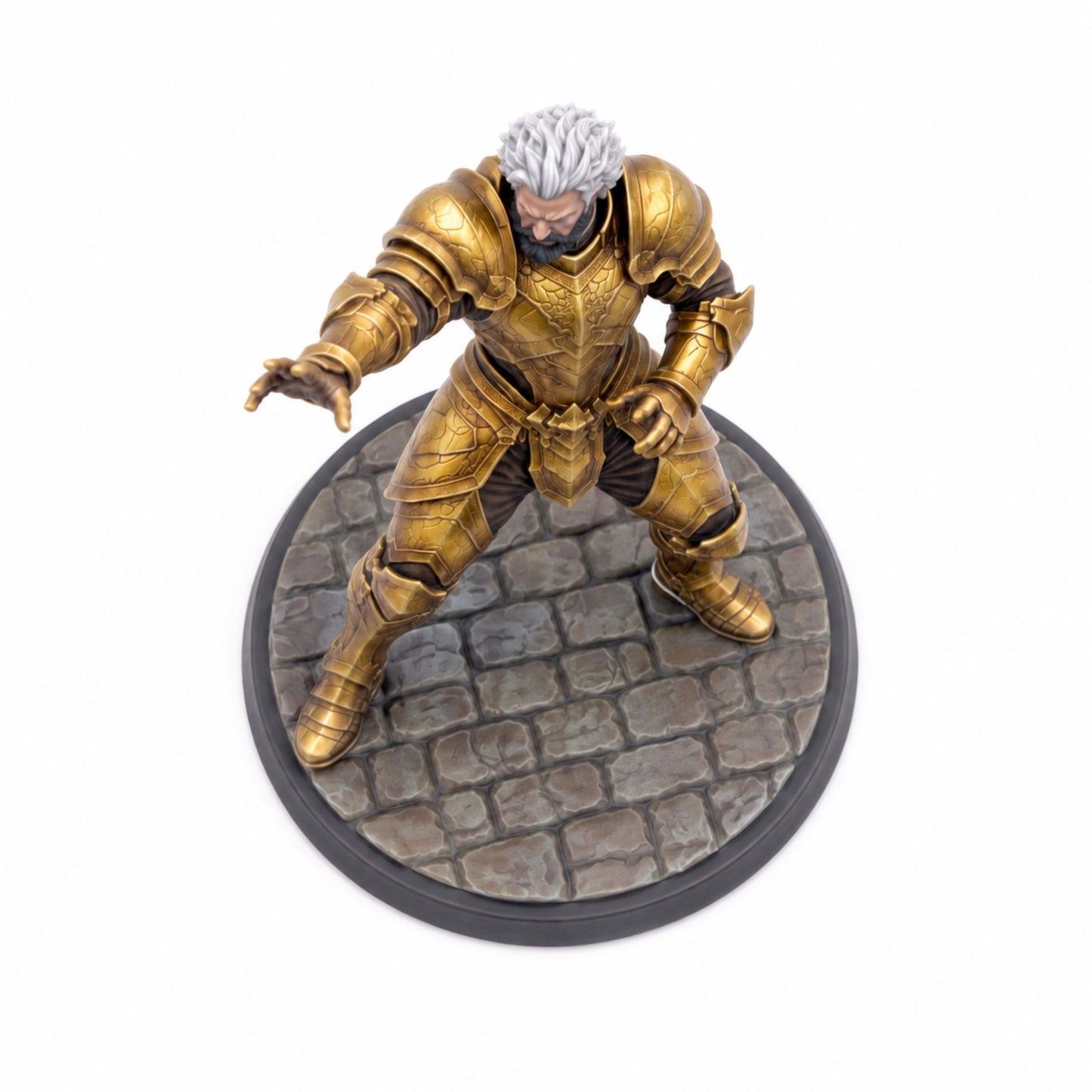
At the heart of this bundle is Merlin, a 40mm resin fantasy miniature inspired by the noble power of the Paladin archetype. With imposing armour, heroic proportions and a commanding pose, Merlin is ideal for use as a player character, champion, guardian, holy warrior or legendary Paladin in your D&D adventures. The miniature is highly detailed and perfect for painting, collecting, displaying or bringing directly into your campaign.

The bundle also includes a luxury Paladin dice set: heavy metal collector dice with a beautiful gold-and-white fantasy design. These are not simple plastic dice; they are premium metal dice with excellent weight, presence and visual impact, ideal for any player who wants their Paladin character to feel truly special at the table.

To help you begin painting your miniature, the set includes two brushes: one larger brush suitable for applying primer or broader base layers, and one fine precision brush for smaller details, armour edges, facial features and controlled colour application.

As a special bonus, this bundle includes free sample paints at no extra cost. These paints are provided as complimentary samples and are not charged as part of the bundle price.

The set includes primer samples in black and white, 3 sample pots of white, 3 sample pots of black, plus 36 sample paint pots with a wide variety of colours, including metallic tones. These samples are ideal for experimenting, testing colour schemes and beginning your miniature painting journey.

What’s included:

1 x Merlin 40mm resin fantasy miniature
1 x premium heavy metal Paladin dice set
1 x brush for primer/base application
1 x precision detail brush
Free sample paints included at no extra cost
Black and white primer samples
3 x white sample paint pots
3 x black sample paint pots
36 x assorted colour and metallic sample paint pots

This bundle is ideal for beginners entering the world of D&D, experienced players looking for a premium Paladin character, collectors of fantasy miniatures, and hobbyists who want a complete first step into painting tabletop heroes.

Important Note: The paints are included completely free as complimentary sample paints. They are provided to help you test colours and begin painting, and they do not add any extra cost to the bundle. Please read the disclaimer in the dropdown above to understand in more detail what these free sample paints include and how to use them.

Merlin — The Paladin Who Sought the Glory of the Kwasar

Name: Merlin
Species: Human
Class: Paladin
Sacred Path: The Path of Ascension
Homeland: The western sanctuaries of Tzion
Core Power: Imperium, the gift of telekinetic command
Great Ambition: To be elevated into a Kwasar
Divine Goal: To receive the blessing of the Astrals, the Architects, or Goddark himself
Main Theme: Glory, discipline, faith, cosmic ascension, and the dangerous hunger for divine power
Signature Quote: “I was born a man, sworn as a paladin, but I shall rise as something the stars themselves must remember.”


Merlin — The Paladin Who Sought the Glory of the Kwasar

In the ancient days of the Tzion Universe, in a remote galaxy lost within that vast Universe, on the Vita Planet called Liberta, there lived a human named Merlin.

He was not born beneath a prophecy.

He was not crowned by destiny as a child.

No comet split the heavens at his birth. No oracle fell to her knees. No celestial voice declared that the infant would one day stand before the gates of divine ascension.

Merlin was born as most men are born: fragile, mortal, uncertain.

But within him burned something that no priest could name and no scholar could measure.

A hunger.

Not for gold.

Not for kingdoms.

Not for the love of crowds or the songs of bards.

Merlin hungered for glory.

Not common glory. Not the glory of soldiers who win battles and are forgotten by the next age. Not the glory of kings whose statues crumble beneath rain and time. Not the glory of heroes whose names survive only as half-remembered legends beside dying campfires.

He wanted something higher.

Something impossible.

He wanted the Glory of the Kwasar.

Across the Cosmos, the word Kwasar was spoken with reverence, fear, and awe. A Kwasar was not merely a warrior. A Kwasar was not merely a mage, a champion, or a blessed knight. A Kwasar was a being elevated beyond the ordinary boundaries of mortal existence.

They were chosen by forces older than history.

Blessed by the Astrals.

Recognised by the Architects.

Forged by trial, sacrifice, and cosmic judgement.

To become a Kwasar was to be transformed into a living vessel of divine power, a being capable of wielding strength that seemed closer to myth than magic. Their bodies became stronger. Their senses became sharper. Their spirits burned brighter. Their weapons became extensions of destiny. Their spells no longer felt like learned formulas, but like commands spoken directly into the bones of reality.

A Kwasar did not simply cast power.

A Kwasar became power.

And Merlin wanted that ascension more than life itself.


The Mortal Beginning

Merlin was raised in the fortress-sanctuary of Aurelion Gate, a sacred stronghold built upon the white cliffs of the eastern lands of the planet Liberta. The fortress watched over a vast valley where ancient roads, ruined shrines, and forgotten battlefields crossed beneath the gaze of the moon.

The paladins of Aurelion Gate were known as the Order of the Dawn Oath.

They were defenders of the weak, guardians of sacred relics, and sworn enemies of corruption. Their armour was polished not for vanity, but as a symbol of spiritual discipline. Their blades were blessed not so they could kill, but so they could stand between innocence and darkness.

From childhood, Merlin was fascinated by them.

He would watch the paladins train in the courtyard at sunrise, their swords flashing like strips of captured light. He watched them kneel before battle, place their hands upon the stone floor of the chapel, and whisper oaths to powers beyond the mortal plane.

Most children admired the paladins because they looked heroic.

Merlin admired them because they endured.

He saw the weight behind their eyes.

He saw the scars hidden beneath their armour.

He saw that every oath cost something.

And that fascinated him.

When he was old enough to train, Merlin did not beg for acceptance. He presented himself before the masters of the Order of the Dawn Oath, placed both hands upon the altar of the First Flame, and spoke with a calmness that unsettled even the elders.

“I do not ask to be protected. I ask to be forged.”

Those words became the beginning of his life as a paladin.

The training was brutal.

He learned swordplay until his palms bled. He learned shieldwork until his shoulders failed. He learned discipline through silence, prayer, hunger, exhaustion, and pain. He learned that a paladin’s first weapon was not the sword, but the will.

Many recruits dreamed of honour.

Merlin dreamed of transformation.

When others prayed for strength, he prayed for purpose.

When others asked the gods for protection, he asked for trials.

When others feared pain, he studied it.

Pain, to Merlin, was evidence that the mortal body still had limits.

And limits were something he intended to break.


The First Sign of Imperium

For many years, Merlin trained as a warrior of faith. He learned the sacred vows of the Dawn Oath, mastered the use of longsword and shield, and studied the holy rites used to channel radiant force against undead, fiends, and corrupted beasts.

Yet his true awakening did not happen in the chapel.

It happened in battle.

The attack came during the winter of the third red moon, when creatures from the ruined lands of Mordrath Vale descended upon the villages beneath Aurelion Gate. They were not ordinary beasts. Their bodies had been twisted by shadow-runes, their bones elongated, their eyes burning with a sick violet light.

The paladins rode out at dawn.

Merlin, still young and not yet fully sworn, was ordered to remain behind with the injured and the children.

He disobeyed.

That act would have earned him punishment under any normal circumstance.

But what happened that day changed everything.

At the village of Harrowfen, Merlin found a scene of horror. Homes burned. Villagers fled through smoke. The beasts had broken through the outer barricade, and one of them, a massive horned creature with black iron fused into its spine, cornered a group of children inside a collapsed chapel.

Merlin charged.

He fought with courage, but courage alone was not enough.

The beast struck him across the chest and sent him crashing through a wooden wall. His sword fell from his hand. His shield cracked. Blood filled his mouth. The creature advanced toward the children.

And then something inside Merlin broke open.

Not his body.

Not his mind.

Something deeper.

A command rose from within him, wordless and absolute.

His fallen sword lifted from the ground.

Not by hand.

Not by spell.

By will.

The blade trembled in the air, surrounded by invisible force. The beast turned, confused. Merlin extended his hand, his fingers shaking, his eyes burning with golden light.

The sword flew.

It struck the beast through the shoulder and pinned it against the chapel wall.

The children screamed.

The creature roared.

And Merlin, half-conscious and bleeding, whispered the first word that came to his soul.

“Obey.”

The broken stones of the chapel floor rose around him.

Wooden beams tore free from the wreckage.

Iron nails ripped from shattered planks.

Everything answered him.

Everything moved.

The world itself seemed to bend toward the command of his mind.

That was the first awakening of Imperium.

The power of telekinetic dominion.

The sacred force of mental authority over matter.

The ability to move, pull, lift, crush, deflect, and command objects through will alone.

When the other paladins arrived, they found Merlin standing in the ruins, surrounded by floating debris, his sword hovering beside him like a loyal spirit.

No one spoke for a long time.

Because every paladin there understood what they had witnessed.

This was not ordinary magic.

This was not a spell taught from a book.

This was a sign.


The Whisper of the Kwasar

After the battle of Harrowfen, Merlin became both admired and feared.

The younger recruits looked at him as if he had already become a legend. The villagers called him blessed. Some priests declared that Imperium was a gift from the Astrals. Others warned that such power could just as easily be a temptation.

The masters of the Order of the Dawn Oath tested him for months.

They asked him to move stones.

He moved statues.

They asked him to disarm a single opponent.

He disarmed six.

They asked him to stop an arrow in flight.

He stopped an entire volley.

But Imperium was not easy to control. It responded not only to focus, but to emotion. When Merlin was calm, objects obeyed him with elegance. When anger touched him, the air itself became dangerous. Doors cracked. Weapons trembled. Candles bent sideways as if bowing before a storm.

The elders warned him.

“Power is not proof of worth.”

But Merlin heard something different.

To him, Imperium was not merely a gift.

It was a doorway.

If his mind could move steel, why could it not move stone?

If it could move stone, why not fire?

If it could command the physical world, could it one day command light, gravity, energy, even the invisible laws woven into the Tzion Universe?

What was Imperium, if not the first step toward something greater?

That was when Merlin began to study the legends of the Kwasars.

He read forbidden chronicles locked beneath the sanctuary.

He studied star-carved tablets recovered from fallen temples.

He memorised the names of beings who had once been mortal but had risen beyond mortality.

There was Astrael the Burning Spear, a warrior who could split mountains with a single radiant strike.

There was Vaelora of the Seven Crowns, who could hear prayers spoken across worlds.

There was Orion Thrice-Blessed, who survived the judgement of three Architects and returned with eyes full of starlight.

And there were others whose names had been erased because their ascension had failed.

That terrified Merlin.

But it also thrilled him.

Because failure meant the path was real.

A false dream has no corpses.

A true path always has those who died walking it.


The Oath Beneath the Starless Sky

The turning point came on the night of the Starless Vigil, a sacred ceremony held once every nine years at Aurelion Gate. During this vigil, the paladins extinguished every flame in the fortress and stood beneath the dark sky in complete silence, remembering the age before light was gifted to the Tzion Universe.

Each paladin renewed their oath.

Each one asked to remain humble, disciplined, and faithful.

But Merlin could no longer pray for humility alone.

He climbed the highest tower of the fortress, carrying only his sword, his shield, and a fragment of black crystal taken from the ruins of Harrowfen. The crystal had once been embedded in the beast he defeated. It pulsed faintly whenever Merlin used Imperium, as if reacting to his inner force.

There, beneath a sky with no stars, Merlin made an oath that no master had taught him.

“I swear by steel, soul, and sacred will. I shall not remain as I was born. I shall climb beyond the limits of blood. I shall seek the gaze of the Astrals. I shall earn the judgement of the Architects. And if Goddark, Father of All Sapiens and Grand Architect of Tzion, looks upon me, I shall not lower my eyes. I shall become worthy of the Glory of the Kwasar.”

The sky remained silent.

No thunder answered.

No angel descended.

No divine flame crowned him.

But far above, beyond the reach of mortal sight, something shifted.

Or perhaps Merlin only believed it did.

From that night onward, belief became his weapon.

And ambition became his burden.


The Conflict Within the Paladin

The tragedy of Merlin is not that he desired greatness.

The tragedy is that he desired greatness for reasons even he did not fully understand.

At his best, Merlin wanted to become a Kwasar so he could protect the innocent on a scale no ordinary paladin ever could. He had seen villages burn. He had heard children scream. He had watched brave men die because their strength was not enough.

He believed the Cosmos needed defenders greater than mortal knights.

He believed evil was evolving.

He believed darkness was no longer content to haunt forests and ruins. It was becoming cosmic. Ancient. Intelligent. Organised.

If monsters were becoming gods, then heroes had to become something greater than heroes.

That was the noble side of his dream.

But there was another side.

A hidden side.

A dangerous side.

Merlin feared being small.

He feared dying as an ordinary man.

He feared being forgotten.

He feared that after all his discipline, sacrifice, pain, and faith, the Cosmos might simply continue without remembering his name.

That fear shamed him, so he buried it beneath noble language.

He told himself it was all for justice.

All for protection.

All for Tzion.

But deep inside, in the place where no prayer could lie, Merlin knew the truth.

He wanted to be chosen.

He wanted the heavens to look upon him and say:

“You are more.”

This inner conflict became the true battlefield of his soul.

Not demons.

Not monsters.

Not rival knights.

The greatest enemy of Merlin was the question he could never escape:

Did he seek ascension to serve the Cosmos…

Or to stand above it?


The Search for a Master

As Imperium grew stronger, Merlin realised that the Order of the Dawn Oath could no longer guide him fully.

They could teach him honour.

They could teach him discipline.

They could teach him how to smite evil, protect the weak, and carry the burdens of a paladin.

But they could not teach him how to become a Kwasar.

The path he wanted was older than the order.

Older than the kingdoms of men.

Perhaps older than Tzion itself.

So Merlin began to search for a master.

Not a swordmaster.

Not a priest.

Not a court wizard who could perform tricks for kings.

He searched for someone who understood ascension.

Someone who had walked near the border between mortality and cosmic transformation.

In forgotten scrolls, he found references to a mysterious being known as Elyndor Vael, the Silent Magister of the Astral Steps.

Some texts claimed Elyndor Vael had once trained warriors who later became celestial champions. Others claimed he was a failed Kwasar, cursed to remain between mortal and divine states. Some said he was not human at all, but a fragment of an Astral wearing the memory of a man.

No legends agreed.

But they all agreed on one thing:

Those who sought Elyndor Vael rarely returned unchanged.

The last known trace of him pointed to the Monastery of the Hollow Star, a ruin hidden beyond the glass deserts of Syrath, where the sand reflected the night sky even at noon and travellers heard voices from possible futures.

When Merlin told the masters of Aurelion Gate he intended to leave, they were not surprised.

The eldest among them, Ser Caldran, gave him one final warning.

“You think power will reveal who you are. It will not. Power only removes the excuses. When you become strong enough, every choice you make will be yours alone.”

Merlin bowed.

But he did not turn back.

At dawn, he left Aurelion Gate with his sword at his side, his shield across his back, the black crystal bound to his gauntlet, and Imperium stirring around him like an invisible storm.

He was no longer merely a paladin.

He was a seeker of ascension.

A mortal walking toward a divine fire.


The Meaning of Imperium

During his journey, Merlin came to understand that Imperium was more than telekinesis.

At first, he believed it was the power to move objects with the mind.

A stone.

A sword.

A door.

An enemy’s weapon.

But the deeper he travelled, the more he sensed that Imperium was not about movement.

It was about authority.

Every object had weight.

Every force had resistance.

Every structure had memory.

To use Imperium, Merlin had to impose his will upon the world without losing control of himself. If his mind was scattered, the power became unstable. If his emotions ruled him, the power became violent. If his purpose was clear, reality obeyed with terrifying beauty.

He learned to pull his sword from across a battlefield.

He learned to raise a shield without touching it.

He learned to stop falling stones in mid-air.

He learned to crush enemy armour inward without piercing flesh.

He learned to leap farther by pushing against the ground with invisible force.

He learned to slow arrows, redirect blades, and hold doors shut against creatures stronger than horses.

But each use of Imperium awakened a deeper hunger.

Because every act proved that the world could be commanded.

And if the world could be commanded, then perhaps destiny could be commanded too.

That thought became dangerous.

Very dangerous.


The Trial of the Glass Desert

The journey to the Monastery of the Hollow Star nearly killed him.

The glass deserts of Syrath were not natural. The legends said that an ancient Architect, originating from a distant Universe, once struck the land with a fragment of celestial wrath, turning the entire region into mirrored sand. During the day, the desert reflected the sun until travellers went blind. At night, it reflected the stars so perfectly that many lost their sense of direction and walked into illusions of heaven.

For seven days, Merlin crossed the desert.

On the third day, he ran out of water.

On the fourth, he began hearing voices.

On the fifth, he saw a vision of himself wearing armour made from some kind of symbiotic being, kneeling before Goddark while a sword of shifting metal, as if the metal itself were alive, appeared before him.

On the sixth, he saw another vision.

This time, he stood above a battlefield of dead companions, his eyes burning like twin suns, his hand raised over a broken city. Around him, people did not cheer.

They trembled.

On the seventh day, he collapsed.

As his body failed, the black crystal on his gauntlet began to pulse. The mirrored sand around him lifted grain by grain, forming a circle of floating glass. Each fragment reflected a different version of his face.

The hero.

The tyrant.

The martyr.

The monster.

The saint.

The conqueror.

Then a voice spoke from nowhere.

“Which one do you seek to become?”

Merlin tried to answer.

No words came.

The voice continued.

“Power will not make the choice. Power will reveal the choice already made.”

When Merlin opened his eyes again, he was no longer in the desert.

He was at the gates of the Monastery of the Hollow Star.


The Silent Magister

The monastery was a ruin of impossible architecture. Its towers curved inward like praying hands. Its windows showed different skies depending on where one stood. Some halls were broken. Others seemed untouched by time. At its centre floated a black star, silent and unmoving, suspended above an empty altar.

There, Merlin met Elyndor Vael.

The master was not what he expected.

He was not a giant warrior.

He was not a shining angel.

He was not a godlike figure wrapped in flames.

He appeared as an old man in plain robes, blind in both eyes, carrying a wooden staff with no ornamentation.

But when Merlin stepped into his presence, every loose stone in the chamber rose from the floor.

Not because Merlin commanded them.

Because Elyndor Vael did.

Without moving a finger.

Without speaking a spell.

Without effort.

The entire monastery seemed to breathe with his will.

“You seek the Glory of the Kwasar,” said Elyndor Vael.

Merlin knelt.

“I do.”

“Why?”

“To protect the Tzion Universe.”

“That is the answer of a paladin.”

“It is the truth.”

“It is part of the truth.”

Merlin said nothing.

The old master stepped closer.

“You also seek to be remembered.”

The words struck harder than any blade.

Merlin lowered his eyes.

For the first time in many years, he felt like a child again.

Elyndor Vael did not condemn him.

Instead, he said:

“Good. A hidden wound becomes poison. A revealed wound can become discipline.”

That was the beginning of Merlin’s true training.


The Path of Ascension

Under Elyndor Vael, Merlin learned that the Glory of the Kwasar could not be stolen, demanded, or achieved by strength alone.

It had to be witnessed.

The Astrals did not bless ambition.

The Architects did not elevate talent.

Even Goddark, creator and sovereign force of the Tzion Universe, did not transform mortals merely because they desired greatness.

A mortal had to become worthy under pressure.

Not once.

Repeatedly.

A candidate for Kwasar ascension had to survive three sacred stages.

The first was Dominion: mastery over one’s gift.

The second was Sacrifice: the willingness to lose what one loves without surrendering to corruption.

The third was Judgement: the moment when cosmic powers looked upon the soul and decided whether it should rise, remain, or be destroyed.

Merlin had only begun the first stage.

Imperium was his doorway into Dominion.

But Dominion did not mean controlling objects.

It meant controlling himself.

For months, perhaps years, time became unclear inside the Monastery of the Hollow Star. Merlin trained in chambers where gravity shifted, where swords attacked without wielders, where stone statues whispered accusations, where illusions forced him to confront versions of himself corrupted by pride.

He had to hold a thousand glass shards in the air without breaking one.

He had to stop a falling pillar while refusing to move the enemy standing beneath it.

He had to fight without anger.

He had to lose without hatred.

He had to win without vanity.

These were harder than battle.

Far harder.

Because in battle, an enemy stands before you.

In ascension, the enemy wears your face.


The Black Crystal and the Coming Enemy

During his training, Elyndor Vael became deeply interested in the black crystal bound to Merlin’s gauntlet.

The crystal was not merely a remnant of the beast from Harrowfen.

It was a fragment of something older.

A shard of corrupted cosmic matter known as Voidglass.

Voidglass was said to form in places where failed ascensions had torn wounds in reality. It absorbed ambition, amplified power, and whispered to those who desired greatness. In the hands of the disciplined, it could become a focus. In the hands of the proud, it could become a curse.

The beast that attacked Harrowfen had not been random.

It had been sent.

Something had sensed Merlin’s awakening before he understood it himself.

Something from beyond the sacred borders of Tzion.

Something that hunted candidates for ascension.

Elyndor Vael named this enemy only once.

Malakar Voss, the Starless Usurper.

A fallen champion who had once sought the Glory of the Kwasar and failed the stage of Judgement. Denied ascension, Malakar Voss turned against the Astrals, cursed the Architects, and began hunting those who might succeed where he had failed.

He did not kill them immediately.

He corrupted them.

He offered power without sacrifice.

Glory without judgement.

Ascension without humility.

To Merlin, this was horrifying.

But also personal.

Because Malakar Voss represented the exact path Merlin feared within himself.

A warrior who had not failed because he was weak.

But because he was unworthy.


Merlin’s Sacred Contradiction

This is what makes Merlin powerful as a character:

He is not a simple hero.

He is not pure in an easy way.

He is noble, but ambitious.

Faithful, but restless.

Compassionate, but proud.

Disciplined, but tempted by impossible power.

He truly wants to protect the innocent. He truly believes the Tzion Universe needs champions strong enough to face cosmic evil. He truly reveres Goddark, the Astrals, and the sacred order of creation.

But he also wants to rise.

He wants to become more than human.

He wants his name carved into the memory of the Cosmos.

This contradiction does not make him evil.

It makes him dangerous.

And fascinating.

Because every time Merlin lifts his sword with Imperium, every time he shields the weak, every time he defeats a monster, the question grows louder:

Is he becoming a saviour?

Or is he becoming the beginning of something that must one day be stopped?


The Paladin’s New Oath

After his training under Elyndor Vael, Merlin did not abandon his paladin vows.

He reforged them.

He became a paladin of the Ascendant Oath, a sacred personal vow built upon three principles:

Protect the small, even while seeking the infinite.

Master power, but never worship it.

Rise only if rising allows others to live.

These words became the chain around his ambition.

Not to imprison it.

To guide it.

His armour was reforged with bronze-gold plates, white steel, and fragments of mirrored glass from Syrath. His shield bore the symbol of a rising star above an open hand, representing Imperium guided by sacred restraint. His sword, once ordinary steel, became known as Oathwake, a weapon that responded to both hand and mind.

In battle, Oathwake could fly back to him when disarmed.

His shield could rotate around him like a floating guardian.

Broken stones could become projectiles.

Enemy weapons could be pulled from their grasp.

And when Merlin entered deep focus, his whole body seemed surrounded by invisible pressure, as if reality itself hesitated before touching him.

But he was still not a Kwasar.

Not yet.

He was only a candidate.

A spark approaching a divine storm.


The Road Ahead

Now Merlin travels across the Tzion Universe, seeking trials worthy of the Astrals’ attention.

He hunts corrupted relics.

He defends sacred sites.

He searches for lost shrines of Goddark.

He confronts servants of Malakar Voss.

He studies every sign of failed ascension, hoping to understand what separates the elevated from the damned.

Some people see him as a hero.

Others see him as a warning.

Villagers call him the Mind-Hand Paladin.

Scholars call him the Imperium-Born.

Enemies call him the Unrisen Kwasar.

But Merlin rejects all titles except one.

Seeker.

Because he knows the truth.

He has not arrived.

He has not been chosen.

He has not yet stood before the Astrals.

He has not yet heard the judgement of the Architects.

He has not yet faced Goddark.

And until that day comes, every battle is a question.

Every victory is a test.

Every use of Imperium is a temptation.

Every act of mercy is a shield against his own pride.

Somewhere in the dark between stars, Malakar Voss watches him.

Somewhere beyond mortal sight, the Astrals measure him.

Somewhere in the sacred architecture of the Tzion Universe, Goddark remains silent.

And Merlin walks forward.

Sword at his side.

Shield at his back.

Mind sharpened like a blade.

Soul burning like a star that has not yet been born.

He is human.

He is paladin.

He is ambition chained to oath.

He is mercy armed with power.

He is the one who would command stone, steel, and destiny itself.

And one day, when the heavens open and the judgement comes, the Cosmos will discover whether Merlin was meant to become a Kwasar…

Or whether the dream of divine glory was the first step toward his fall.


This work includes material from the System Reference Document 5.2.1 (“SRD 5.2.1”) by Wizards of the Coast LLC, available at D&D Beyond. The SRD 5.2.1 is licensed under the Creative Commons Attribution 4.0 International License.

What Is a Paladin?

A paladin is not simply a warrior with holy magic. A paladin is a battlefield guardian, an oath-bound champion, a divine defender whose power comes from conviction. In the SRD 5.2.1 system, the paladin stands between the Fighter and the Cleric: tougher and more martial than most spellcasters, but far more sacred, symbolic and mystical than a simple soldier.

A Fighter wins through weapon mastery.

A Cleric channels divine power through prayer.

A Paladin does both, but with one crucial difference: the paladin’s entire identity is built around an oath.

That oath is not decoration. It is the engine of the class. The paladin’s strength is not only muscle. It is belief turned into armour. It is discipline sharpened into steel. It is moral force made playable.

Using Merlin as the example, he is exactly the kind of character who makes the paladin archetype powerful: human, ambitious, disciplined, sworn to a sacred path, but dangerously hungry for ascension. His lore defines him as a Human Paladin whose Sacred Path is the Path of Ascension, whose core power is Imperium, and whose ambition is to be elevated into a Kwasar.

That means Merlin is not “just a knight.” He is a mortal trying to become worthy of cosmic glory.

The Paladin’s Core Fantasy

The fantasy of the paladin is this:

A warrior walks into darkness not because he is fearless, but because he has sworn that fear will not rule him.

A paladin wears armour because others cannot.

A paladin carries a shield because someone must stand first.

A paladin draws a sword not for violence, but for judgement.

A paladin heals because mercy is part of strength.

A paladin smites because some evils cannot be negotiated with.

Merlin embodies this beautifully. He begins as a fragile mortal, not born under prophecy, not chosen by obvious destiny, but driven by hunger for higher glory. That is very paladin-like: the oath comes before the miracle. The discipline comes before the divine sign. The vow comes before the power.

Primary Abilities: Strength and Charisma

In SRD 5.2.1, the paladin’s primary abilities are Strength and Charisma.

Strength represents the physical side of the paladin: armour, sword, shield, body, endurance, battlefield presence. A paladin must be able to wear heavy armour, hold the line, strike in melee and protect weaker allies.

Charisma represents the sacred side: conviction, spiritual authority, divine force, oath-power, presence, command and aura. For a paladin, Charisma is not just charm. It is the strength of the soul.

For Merlin, this is perfect. His Strength is the trained body of the paladin. His Charisma is the fire of his oath, the force of his ambition, and the terrifying authority behind Imperium. When Merlin says “Obey” and reality bends around him, that is not only telekinesis in the story. In game language, it feels like Charisma expressed as supernatural command.

A good Merlin-style paladin should therefore not be built as a dumb brute. He should feel like a warrior-saint: physically dangerous, spiritually intense, disciplined, persuasive, intimidating and almost radiant with inner pressure.

Armour: Why Paladins Feel So Powerful on the Battlefield

The SRD gives paladins training in light, medium and heavy armour, plus shields.

That is extremely important. It means the paladin can be one of the most durable front-line characters in the party. Visually and mechanically, the paladin belongs at the front.

Typical paladin armour can include:

Chain mail as a classic starting image.

Splint or plate later, if the campaign allows access to better equipment.

A shield for maximum defence.

A holy symbol displayed on the shield, armour, weapon or amulet.

For Merlin, the armour should not look like generic medieval armour. It should tell his story. His armour could be white steel and bronze-gold, with mirrored fragments from Syrath, as your lore already describes. His shield bears a rising star above an open hand, symbolising Imperium controlled by sacred restraint. That is excellent design because it connects game function with lore meaning: the shield is not only AC; it is Merlin’s philosophy.

The armour says:

“I seek ascension, but I remain bound by oath.”

Weapons: The Paladin as Sacred Weapon-Master

The SRD gives paladins proficiency with simple and martial weapons.

This makes the paladin flexible. He can fight with sword and shield, two-handed weapons, polearms, javelins, maces, hammers or lances. But the classic paladin image is:

Longsword and shield.

Greatsword for a more aggressive holy warrior.

Warhammer or mace for a temple-knight aesthetic.

Javelins for ranged backup.

For Merlin, the best weapon is clearly the longsword. His sword Oathwake is already perfect as a signature paladin weapon: a blade that responds to both hand and mind. In normal SRD terms, it can simply function as a longsword. In lore terms, Merlin’s Imperium allows him to recall it, suspend it, guide it or make it orbit like a weapon of judgement.

Mechanically, unless you create a homebrew feature, Oathwake should still be treated as a normal weapon or a magic weapon approved by the Game Master. The story can describe it as telekinetically responsive, but the actual rules should stay balanced.

A simple implementation could be:

At low levels, Oathwake is a normal longsword.

At mid levels, it becomes a magic longsword.

At higher levels, it could become a Holy Avenger-style legendary weapon, especially because the SRD includes the Holy Avenger as a legendary weapon requiring attunement by a paladin.

For Merlin’s lore, that would be incredible: Oathwake could one day awaken into a Kwasar-judged weapon.

Lay On Hands: The Paladin’s Mercy

At level 1, the paladin gains Lay On Hands. This gives the paladin a healing pool equal to five times paladin level, replenished after a Long Rest. The paladin can use it as a Bonus Action to touch a creature and restore Hit Points, or spend points from the pool to remove the Poisoned condition.

This is one of the most important paladin features because it defines the class morally.

The paladin is not only the one who kills the monster.

He is the one who kneels beside the dying villager.

He is the one who places a bloodied hand over a wound and says, “Not yet.”

For Merlin, Lay On Hands should feel solemn. It is not casual healing. It is the moment where his ambition is tested. Does he use his power for glory, or does he spend it quietly to save the weak?

This is where Merlin becomes fascinating. Every time he heals someone, he proves that his oath still chains his ambition to mercy.

Spellcasting: Prayer, Meditation and Sacred Preparation

In SRD 5.2.1, paladins cast spells through prayer and meditation. Charisma is their spellcasting ability, and they can use a Holy Symbol as a spellcasting focus.

That means Merlin’s spellcasting is not wizardry. He is not studying arcane formulas like a Wizard. He is invoking oath, faith and sacred will.

Paladin magic should feel direct, radiant and practical. It protects, blesses, heals, purifies, reveals evil, strengthens allies and punishes enemies.

The SRD paladin spell list includes level 1 spells such as Bless, Command, Cure Wounds, Detect Evil and Good, Divine Favor, Divine Smite, Heroism, Protection from Evil and Good, Searing Smite and Shield of Faith. Higher-level paladin spells include Aid, Find Steed, Lesser Restoration, Magic Weapon, Shining Smite, Zone of Truth, Revivify, Banishment, Aura of Life, Death Ward, Dispel Evil and Good, Greater Restoration and Raise Dead.

For Merlin, the most thematic spells are:

Bless, because Merlin inspires others through sacred discipline.

Command, because it mirrors Imperium and his authority over matter and enemies.

Shield of Faith, because he is a defensive paladin.

Heroism, because his story is about glory, fear and courage.

Divine Smite, because his blade becomes judgement.

Find Steed, because a paladin of ascension should eventually ride something symbolic, perhaps not just a horse but an astral war-steed.

Zone of Truth, because Merlin’s greatest conflict is truth: does he seek ascension to serve or to be remembered?

Banishment, because cosmic evil and failed ascension entities fit his lore.

Greater Restoration and Raise Dead, because late-stage Merlin should feel like a holy champion whose presence can reverse catastrophe.

Divine Smite: The Paladin’s Signature Strike

At level 2, the paladin gains Paladin’s Smite. In SRD 5.2.1, the paladin always has Divine Smite prepared and can cast it once without expending a spell slot, regaining that free use after a Long Rest.

Divine Smite is the iconic paladin moment.

In fiction, this is when the sword stops being steel and becomes verdict.

For Merlin, Divine Smite should look like Oathwake blazing with white-gold force while Imperium holds the enemy in place for a fraction of a second. The blade falls, radiant energy erupts, and the strike feels less like an attack and more like reality agreeing that the enemy must be punished.

In game implementation, Smite is especially important because the paladin can fight normally with weapons and then use spell power to create burst damage. That makes the paladin dangerous in decisive moments. The class is not always the highest-damage character every round, but when the paladin chooses the right moment, the impact can be brutal.

Weapon Mastery: Martial Discipline, Not Just Holy Power

At level 1, the SRD paladin also gains Weapon Mastery with two kinds of weapons with which they have proficiency, and can change those choices after a Long Rest.

This matters because it reinforces that a paladin is a trained combatant. The paladin is not a priest who picked up a sword. The paladin is a true martial warrior.

For Merlin, Weapon Mastery should represent years of training at Aurelion Gate. His swordplay, shieldwork, javelin drills and battlefield discipline come before his cosmic ambition. Imperium makes him special, but training makes him reliable.

Fighting Style: Choosing Merlin’s Combat Identity

At level 2, the paladin gains a Fighting Style feat or the Blessed Warrior option, which grants two Cleric cantrips treated as paladin spells using Charisma.

For Merlin, there are three strong directions:

Sword and shield defender: best if you want Merlin to feel like a classic holy knight, very durable, standing in front of allies.

Great weapon ascendant: best if you want him to feel more aggressive, like a warrior chasing glory with terrifying radiant strikes.

Blessed Warrior: best if you want his sacred/mystical side to be more visible, giving him cantrips such as Guidance or Sacred Flame.

For the Merlin you have written, I would choose sword and shield first. His whole theme is ambition restrained by oath. The shield matters symbolically. He wants cosmic ascension, but he still carries the defensive burden of a paladin.

Channel Divinity: Sacred Energy Made Action

At level 3, the paladin gains Channel Divinity. In SRD 5.2.1, the paladin starts with Divine Sense, allowing awareness of Celestials, Fiends and Undead within range, plus consecrated or desecrated places or objects.

This is crucial for storytelling. It means the paladin does not see the world like normal people. A paladin senses spiritual wrongness. A cursed chapel, a desecrated relic, an undead presence behind a wall, a fiend hiding under noble manners: these are exactly the kinds of things a paladin can bring into the story.

For Merlin, Divine Sense could be described as Imperium becoming silent. When evil is near, the air stops obeying naturally. Metal vibrates. The black crystal on his gauntlet pulses. His holy symbol grows warm. He does not merely “detect evil”; he feels the architecture of creation become disturbed.

Oath and Subclass: The Soul of the Paladin

At level 3, the paladin chooses a subclass. The SRD includes Oath of Devotion, which binds paladins to justice and order. Its tenets include keeping one’s word, protecting the weak, acting without fear and becoming an example through honourable deeds.

This is very close to Merlin’s original Order of the Dawn Oath, but Merlin’s personal path goes further. In your lore, he later reforges his vows into an Ascendant Oath:

Protect the small, even while seeking the infinite.

Master power, but never worship it.

Rise only if rising allows others to live.

That is excellent. Mechanically, you can run Merlin as an Oath of Devotion paladin from the SRD while presenting his personal oath in the lore as the Path of Ascension. That keeps the rules compatible with SRD 5.2.1 while allowing your Tzion/Kwasar identity to remain original.

In other words:

Rules chassis: Paladin, Oath of Devotion.

Lore identity: Merlin, Paladin of the Ascendant Oath.

Cosmic theme: a mortal seeking the Glory of the Kwasar.

Extra Attack: The Paladin Becomes a True Front-Line Threat

At level 5, the paladin gains Extra Attack, allowing two attacks instead of one when taking the Attack action.

This is a major power jump. At this point, Merlin no longer feels like a young holy warrior. He becomes a serious battlefield presence.

A typical turn could look like this:

Merlin advances in heavy armour.

He attacks once with Oathwake.

He attacks again.

If one strike lands at the perfect moment, he unleashes Divine Smite.

If an ally is wounded, he uses Lay On Hands as a Bonus Action.

This is why paladins feel so heroic. They can attack, heal, protect and burst with radiant power without losing their identity.

Faithful Steed: The Knight Becomes Mythic

Also at level 5, the paladin gains Faithful Steed, always preparing Find Steed and gaining one free casting per Long Rest.

This is one of the most cinematic paladin features. A paladin with a steed becomes a knight of legend.

For Merlin, the steed should not be random. It should represent the next step toward ascension. Perhaps he summons an astral white warhorse with mirrored eyes. Perhaps the steed is born from the Dawn Oath. Perhaps it is the first sign that the Astrals are watching him.

In a Tzion campaign, Merlin’s steed could be called:

Aurelion

Starwake

Vigilant

Pegasus if you want a direct mythic connection

Or, later, it could evolve into something Kwasar-like: not just a mount, but a symbol that Merlin is approaching divine judgement.

Aura of Protection: The Paladin as a Living Shield

At level 6, the paladin gains Aura of Protection. The paladin and allies within the aura gain a bonus to saving throws equal to the paladin’s Charisma modifier.

This may be the most important paladin feature in the game.

Why? Because it means the paladin protects the party simply by standing near them.

He does not need to attack.

He does not need to heal.

His presence itself makes others stronger.

For Merlin, this is beautiful because it challenges his ambition. If he truly wants to become a Kwasar, the question is not merely how much power he can command. The question is: does his presence elevate others?

A false ascendant dominates.

A true paladin protects.

Aura of Protection is the rule that makes that philosophy playable.

Aura of Courage and Devotion: Fear and Charm Cannot Rule the Faithful

At level 10, the paladin gains Aura of Courage, granting immunity to the Frightened condition to the paladin and allies while within the Aura of Protection.

For the Oath of Devotion, Aura of Devotion also grants immunity to the Charmed condition while in the aura.

This is extremely thematic. Paladins are not only damage dealers; they are morale anchors. They make the party harder to break mentally and spiritually.

For Merlin, this should be described as his oath stabilising the battlefield. When Malakar Voss or a corrupted relic tries to bend minds, Merlin’s aura becomes a zone of sacred refusal. Fear approaches and breaks. Temptation whispers and finds no entrance. Allies look at him and remember who they are.

Radiant Strikes: Every Hit Becomes Supernatural

At level 11, the paladin gains Radiant Strikes: when hitting with a melee weapon or Unarmed Strike, the target takes extra Radiant damage.

This is the moment where the paladin’s ordinary attacks stop feeling ordinary.

For Merlin, it means Oathwake no longer needs to flare only during Smite. Every strike carries the memory of the oath. Every cut shines with restrained celestial fire. Even when Merlin is not spending a spell slot, his weapon has become sacred.

Restoring Touch: The Paladin as Cleanser of Corruption

At level 14, the paladin’s Lay On Hands improves through Restoring Touch, allowing the paladin to remove conditions such as Blinded, Charmed, Deafened, Frightened, Paralyzed or Stunned by spending points from the healing pool.

For Merlin’s story, this is extremely useful because his enemies are not only physical monsters. They are corruptions, failed ascensions, Voidglass influences, mind-breaking trials and cosmic fears.

Restoring Touch lets Merlin feel like a sacred healer-warrior who can bring someone back from spiritual collapse.

Holy Nimbus: The Paladin at Mythic Height

At level 20, the Oath of Devotion paladin gains Holy Nimbus, empowering the Aura of Protection with holy power. It grants benefits including advantage on saves forced by Fiends or Undead, radiant damage to enemies starting their turn in the aura, and sunlight within the aura.

For Merlin, this is almost the threshold before Kwasar ascension.

At level 20, he should feel like a living dawn.

His armour burns with white-gold light.

Oathwake becomes a line of radiance.

His aura becomes sunlight.

Undead and fiends cannot stand near him without being judged.

At this point, Merlin is still technically human and still technically a paladin, but narratively he is approaching the moment where the Astrals might finally look upon him.

How to Build Merlin as a Paladin in SRD 5.2.1

A strong SRD-compatible version of Merlin would look like this:

Class: Paladin.

Species: Human.

Primary abilities: Strength first, Charisma second, Constitution third.

Background: Soldier or Acolyte, depending on whether you want to emphasise martial training or sacred upbringing.

Subclass: Oath of Devotion, reflavoured in lore as the Ascendant Oath.

Weapons: Longsword and shield.

Armour: Chain mail at the start, later plate.

Holy Symbol: The rising star above the open hand.

Signature weapon: Oathwake, initially a longsword, later possibly a magic weapon.

Signature theme: Divine Smite described as radiant Imperium focused through the blade.

Signature conflict: Does Merlin seek power to protect others, or to be remembered by the Cosmos?

Suggested Ability Scores for Merlin

Using the SRD standard array logic, the paladin recommendation places high values in Strength and Charisma.

For Merlin, I would arrange him like this before background increases:

Strength 15

Charisma 14

Constitution 13

Wisdom 12

Dexterity 10

Intelligence 8

But if you want Merlin to feel more scholarly and ascension-obsessed, you could swap Intelligence and Dexterity:

Strength 15

Charisma 14

Constitution 13

Wisdom 12

Intelligence 10

Dexterity 8

This makes him less agile but more fitting as someone who studies forbidden chronicles, Kwasar legends and cosmic lore.

Merlin’s Imperium in Game Terms

Imperium is not a standard paladin feature in the SRD. It is your original lore power. So, to keep the game compatible and balanced, Imperium should be implemented carefully.

There are three good ways to handle it:

First, as flavour. Merlin casts Command, Shield of Faith, Divine Smite or Magic Weapon, but the description says invisible force bends around him. This is the safest method.

Second, as selected spells. You can choose spells that feel telekinetic or commanding when available through class features, items or GM-approved options.

Third, as a custom feature. The Game Master can design a limited Imperium ability, such as moving small objects, pulling Oathwake back to Merlin, or imposing a Strength saving throw to push or restrain a creature. This should be limited by uses per Long Rest or tied to Channel Divinity so it does not overpower the class.

The key is this: Imperium should enhance Merlin’s paladin identity, not replace it.

He is not a Wizard.

He is not a Sorcerer.

He is a paladin whose oath is so intense that reality begins to obey.

Merlin in the Three Pillars of Play

D&D is not only combat. The SRD describes play through social interaction, exploration and combat.

In social interaction, Merlin uses Persuasion, Intimidation, Insight and Religion. He can inspire villagers, interrogate cultists, confront corrupt nobles, or speak before sacred orders. His Charisma makes him powerful outside combat.

In exploration, Merlin detects desecrated places, protects the party, survives dangerous ruins, interprets religious symbols and acts as the moral compass when the group faces cursed relics or forbidden doors.

In combat, Merlin holds the front line. He protects allies with armour and aura, heals with Lay On Hands, attacks with sword and shield, uses Divine Smite for decisive burst damage, and stands against undead, fiends and corrupted cosmic enemies.

The Paladin’s Moral Gameplay

The paladin is one of the best classes for roleplay because it constantly asks moral questions.

Will you keep your word when lying would be easier?

Will you protect the weak when there is no reward?

Will you spare an enemy who might return?

Will you accept humiliation to preserve your oath?

Will you choose mercy when glory demands violence?

For Merlin, these questions are even stronger because his ambition is dangerous. He wants the Glory of the Kwasar. He wants the Astrals, the Architects or Goddark himself to judge him worthy. But a paladin cannot simply chase power. A paladin must prove that power will not corrupt the oath.

That is Merlin’s central dramatic engine.

A Fighter asks: can I win?

A Wizard asks: can I understand?

A Rogue asks: can I survive?

A Paladin asks: can I remain worthy?

Merlin asks something even more dangerous:

Can I rise beyond humanity without losing the part of me that deserved to rise?

Final Definition

A paladin in SRD 5.2.1 is an oath-bound divine warrior: heavily armoured, trained in martial weapons, empowered by Charisma-based sacred magic, able to heal, smite, protect, detect supernatural evil and strengthen allies through auras. Mechanically, the paladin is a front-line defender and burst-damage striker with healing and support. Narratively, the paladin is a living vow.

Merlin is a perfect paladin because he is not pure in a boring way. He is noble, but ambitious. Merciful, but hungry for glory. Faithful, but tempted by cosmic power. He protects the weak, but dreams of being chosen by the highest forces of the Tzion Universe. That tension makes him more than a class build.

It makes him a story.

Merlin is the paladin who does not merely ask the gods for strength.

He asks the Cosmos whether a mortal can become worthy of ascension.

View full details